The Lay System has generated five selections for tomorrow. They are: Portsmouth, Swansea City, Forest Green Rovers, Kidderminster Harriers and Forfar Athletic.
I shall be laying each of the five to a loss of £10.85, but following a comment from A. Nonymous last Saturday it may be wise to exclude two of these selections, namely Portsmouth and Forfar as they are both playing teams that have nothing to play for. He/she has a valid point, so I shall be watching these two results with special interest. Forfar are the shortest price at 2.74, Portsmouth are longest at 3.3, and the others are in-between at 3.25 (Swansea), 3.0 (Forest Green) and 3.15 (Kidderminster).
Result: I guess stranger things have happened in the history of football, but Kidderminster was not one of my system’s best ever selections winning by no less than 6-1 at Halifax, who previously had lost just three times at home all season. Such is life. I guess Halifax are resigned to playing in the Conference North next season.
Portsmouth also let me down by trying too hard in one of the two games where my selection was playing a team with nothing to play for. At least Forfar didn’t win, but I would have been better off excluding both these selections.
All in all, not a very good night with two losses from just five selections. I shall update the numbers later. As the commenter on Saturday said, we are entering a tricky time of the year with so many games involving either one or sometimes both teams who have nothing to play for. I am thinking that I shall heed his advice and drop those matches from my list. Watch this space.
Tuesday, 8 April 2008
Tuesday Football Lays 8 April


Sunday, 6 April 2008
Total Match Points Markets in Basketball
These markets must be the most annoying anywhere on Betfair. I've just been watching the Memphis Tigers / UCLA game and the unders looks a shoo-in with less than three minutes left, and Memphis up by double figures. But no. UCLA keeps fouling, time after time, and for what? The game is lost. Memphis might miss the occasional free-throw, but they're not going to miss anywhere near enough to make the game even close. I can only guess that they do it just to annoy me and cost me money. Actually, the worst thing about losing this kind of a bet is not the money. It's knowing that somewhere out there, someone out-witted me. That is not something that sits well with me! But onward and upward. Another game coming up, and so long as the lesson is learned (stay away from these markets), no real harm I suppose.
Update: A poster on the forum just commented that there were 26 points in the last three minutes - in a game that wasn't even close!
Saturday, 5 April 2008
Saturday Baseball
Two selections for tonight.
On the mound for the Padres tonight is Cy Young award winner Jake Peavy, who picked up a win on opening day, so my selection is the San Diego Padres (1.7) to beat the admittedly impressive Los Angeles Dodgers. When the Padres take the lead, I shall be looking to lay off at around 1.35.
Result: Padres won 4-1 with a full game from Jake Peavy.
I am persisting with the Detroit Tigers at 1.7 to beat the Chicago White Sox with Dontrelle Willis pitching his debut in the American League. Their awful start can't continue for ever. (Famous last words).
Result: First, the good news - the Tigers went 3-0 up. Last, the bad news. They are still totally inept and lost 3-5. Maybe this awful start CAN last for ever.
Saturday Football Lays April 5
The bank stands at £1,070.28 so today I am laying to 1% on 20 selections, which are: Sheffield Wednesday (playing at noon) followed by Tottenham Hotspur, Sunderland, Bristol City, Burnley, Charlton Athletic, Hartlepool, Oldham Athletic, Tranmere Rovers, Barnet, Brentford, Darlington, Macclesfield, Morecambe, Oxford United, York City, Dunfermline, Livingston and Airdrie at 3:00pm and at 5:15pm, Exeter City. All prices are between 2.84 and 3.6.
The system to date has a strike rate of 82.1% so I'm prepared for four losers, but anything less than six would be great. Six, ho-hum. Anything more than six, not so great.
Update: For some reason, a big drop in the price of the home team has eliminated three of my selections from contention, and they are Barnet, Macclesfield and Dunfermline. Early this morning I left lays in the market, and my strategy is to leave them alone until 2:30 and see how many have not been taken. One of the four unmatched selections was Tottenham Hotspur, who had drifted slightly and I adjusted my bet accordingly. The other three (mentioned earlier) had all drifted significantly so I am dropping them. I did not have this issue last week, so it will be interesting to see how those teams fare today. The Barnet bet had actually been partly matched at 3.2, but then drifted out to 3.75 so I was able to green-up on this one (for peanuts, but I am not allergic to peanuts, especially risk-free ones). If anyone knows why the price drifted out so much on any of these games, please enlighten me. Presumably some significant team news.
Result: Sheffield Wednesday did not win, so a winning start to the day.
Result: 12 of the other 16 games played so far resulted in the predicted four losses (next week I'll try predicting no losses) so the bank now stands at £1,085.24.
In the final game of the day, I have layed Exeter City for £4.52 at 3.4 to lose £10.85.
Result: ...and shouldn't have done! Exeter won, so I lost.
The bank is now at £1,074.38 - up just £4.10 on the day. As I said in the original post - ho-hum. But a profit is a profit.
Tennis
Does anyone sitting at home actually manage to make money consistently by betting on tennis in-running?
I long ago realised that I was always going to be behind court-siders or people who had access to court-side information, but I have had some success with 'playing the numbers' (backing when the weight-of-money indicates I should, and then laying off) but it is stressful to say the least.
Tonight I am looking at the numbers jumping around as Andy Roddick is playing Nikolay Davydenko and with Davydenko a set up, I decided to jump in with a bet on him at 1.73. As per usual, (or so it seems), the price then immediately moves against me, and my heart rate goes over 100, (or at least it feels like it). About two hours later, ok, more like five minutes later, the price is back down to where I backed at, and then drops still further, to 1.66, at which point I lay-off, leaving zero on Roddick, and all the green on Davydenko.
Why did I lay off at that time? I think it's because the market initially moved against me, so psychologically I say to myself "If I can get out of this even, I'll be happy" and thus when the opportunity to get out with a nice profit presented itself, I took it. Tennis being what it is, had I waited just a few more minutes I could have layed off closer to 1.3, (at which point I went Green-all-Over) and it wasn't that long before the game was over in straight sets and I could have greened up at 1.0x.
Maybe I should play with smaller amounts (I put £900 on and wouldn't have been happy to lose that!), or lay-off part of the bet. Maybe I should have let the bet run, and traded out at a loss only if the market moved against me. In the end, I came away with £47.23, about 5% of my initial investment, but I can't help feeling I should have made more. But a win is a win.
One of the problems with Betfair, when compared with the stock market, is that there is no ability to put a stop-loss bet into the market, for example a bet to lay at 2.0 to close my 1.73 position for a controlled loss, since that would be immediately matched if I didn't want it to be taken (the bet is still in good shape) or would remain unmatched if I DID want it to be (the bet is awful and no one is interested!)
Anyone any thoughts, comments or ideas?
Friday, 4 April 2008
Friday Baseball
Slight after-timing here - I didn’t realise the game started so early, but I am on the Detroit Tigers (1.7) with Nate Robertson pitching to finally get their first win of the season against the Chicago White Sox. I can’t see the Tigers’ losing run continuing much longer, and as I write this, the game is tied at 2, top of the 3rd.
Update: Should have just kept quiet. The inept Tigers fell short again, and now have a less than impressive 0-4 record to start the 2008 season.
Friday Football Lay
Today, there is one selection for the Football Laying System (I need a catchy name for this, any ideas?) which is Dagenham and Redbridge (3.2) playing at Accrington Stanley in a League Two fixture. I am laying £10.65 hoping to to win £4.64 (pre-commission).
Result: Dagenham and Redbridge (both...) lost, so the bank increases to £1,070.28 and the selections tomorrow, and there will be a few, will all be layed to 1% of that, i.e. £10.70.
Thursday, 3 April 2008
Thursday Baseball / Basketball
Tonight's selection is the Detroit Tigers (1.58) to get their first win of the season behind Jeremy Bonderman in their home again against the Kansas City Royals.
Only three NBA games tonight, and nothing of value. At this time of year, with teams looking forward to the play-offs, one needs to be careful. Quite often a team would appear to be better off losing a couple of games and dropping down to play a weaker team, albeit a higher seeded one and players are often rested in these situations or if the play-off spot is locked in and they have nothing more to play for. I shall probably keep an eye on these games as they go in-play though. Prices can be volatile and value can often be found during the game. Good luck.
Update: Cleveland Cavaliers (1.32) are the pick for this morning. As always, I shall be looking to go Green-all-Over when the price drops to 1.11 or so.
MLB Result: Tigers were hopeless (again) last night. They lost to the Kansas City Royals 1-4 to open the season 0-3 at home. Not what I expected from them at all!
NBA Result: The Cavaliers managed to drop a 14 point lead, not that unusual an occurrence in the NBA, and lost 108-111, but because I layed off at 1.11 to go Green-all-Over, I'm writing this update in green. Cleveland actually traded as low as 1.04. More evidence that going green-all-over in the NBA is a good strategy.
March Summary
Overall March was a good month. My football bets showed a healthy profit with the 'going-live' of my football laying system. I initially noticed an edge back in the summer, but because the games were an obscure mixture of Scandinavian games, Austrian, Under-20 World Cup matches, MLS, pre-season friendlies and others, I didn't pay too much heed to it.
Earlier this year I came across the original spreadsheet (I'm a nerd - I record everything) and decided to monitor English and Scottish fixtures for a while. As of 31st March, 274 games had been tracked and the pattern I'd noticed in the summer was again evident. Although this is still a work in progress, the current selection criteria would have resulted in 95 winning lays from 116 selections.
Like many others, I read the story of Maria and her laying system with much interest, and although there are some sceptics around, I have no reason to doubt that her discipline and selections combined to make her a nice sum of money. Inspired by the story, I decided to start with a bank of £1,000 and attempt to replicate her success. The big difference between her system and mine is that with only three outcomes possible, the odds I am laying will seldom exceed 4.0. The longest I have layed so far was 3.8. Therefore, her formula for calculating the bank percentage to risk each time is redundant, and I am laying to a fixed 1%. However, I may tinker with this in the future and adopt the idea of having different percentages for different bands of prices. For now I am keeping it simple.
Also, for ease of calculating winnings, I am assuming a 5% commission deduction, although my discount rate is currently 16%. Therefore my actual profits will be slightly higher than those reported.
At the end of March, the system had 18 wins from 21 selections, and the bank stood at £1,052.01 laying each selection to lose £10.62.
Wednesday, 2 April 2008
Wednesday Baseball / Basketball
Tonight's selection is for the San Diego Padres to continue their strong start to the season behind Greg Maddux at 1.74 and beat the Houston Astros.
In the NBA, look for the Cleveland Cavaliers (1.64) to be too strong for the Charlotte Bobcats but as always this time of year, be wary for any team news on resting players. Good luck.
NBA Result: The Cleveland Cavaliers won a close game 118-114.
MLB Result: All-time saves leader Trevor Hoffman blew a 6-5 lead in the top of the 9th, and the Padres fell to a 6-9 loss. However, I am putting this result in green because my lay at 1.1 was taken allowing me to go Green-all-Over, although not as green on the Astros as I was the Padres. The Padres actually traded at 1.01 (gubbed as they say) when they were one out away from a win in the top of the ninth - someone got a little too greedy. Very poor liquidity though.
Tuesday, 1 April 2008
Tuesday Baseball
Today's baseball selection is the Los Angeles Angels of Anaheim (1.86 with Jon Garland pitching) to beat the Minnesota Twins. The Angels came up a little short yesterday, but I expect them to win tonight.
MLB Result: Angels won 9-1
Monday, 31 March 2008
Tuesday Football Lays
My Football Lay System continues tomorrow with three selections which are Forfar (3.15), Queen of the South (2.92) and Wrexham (3.35).
To date the system has produced 92 winning lays from 113 selections ( 81.4%) - a level stakes profit of 49.77 to a 1.00 stake.
Update: I have now added Ebbsfleet to my selections at 3.45.
Football Result: Whilst others may consider the Champions’ League quarter-finals rather more important, the highlight of tonight’s football action for me is a clean sweep for my laying system, with all three selections losing, (Forfar was a postponement), and the starting bank of £1,000 increasing to £1,065.68.
MLB Opening Day
A win on the baseball last night, with the underdog Washington Nationals taking a 2-0 first inning lead at home to the Atlanta Braves. The Braves tied it up in the top of the ninth before a walk-off home run in the bottom of the ninth won it for the Nationals.
A full schedule of games tonight which should offer some value. Early in a season I tend to keep my stakes small and go with the underdogs pre-game with a view to laying off in running, but my bet of the night is the Los Angeles Dodgers who I feel are value at 1.55 to beat the San Francisco Giants.
MLB Update: The Dodgers scored 3 in the first and shut out the Giants 5-0.
Sunday, 30 March 2008
Following Your Own Advice
On Xmas Eve last year, John "The Gambler" posted a list of 20 questions / comments when asked for advice on successful investing. You can check his full list of rules at http://john2e.typepad.com/ Most of them are common sense, but I am highlighting numbers 17 and 20 which are:
17. Don't drink and bet.
20. Don't chase your losses.
It is therefore sad to read in his blog that yesterday's losses were, in his own words, down to "Mainly horse racing after one too many lagers" and on February 23rd he says "Somehow nearly 5K up on the month. Not quite sure how. Probably as I keep bringing in the tanks to get out of trouble. Not a good strategy in the long term".
...after one too many lagers? ...bringing in the tanks? (high stakes at low odds)
Now John seems a genuinely nice guy and I wish him all the best, but I have to agree with the commenter on his blog who wrote that this was an accident waiting to happen. In mitigation he has had a few 'off-field' issues lately which have no doubt been distracting, but if he returns to trading, I hope he heeds his own advice. Making money at this game is not easy, but discipline, whether it be not drinking or controlling your stakes, is absolutely vital at all times. Good luck John.
To Green Or Not To Green?
When time permits, I occasionally browse the forum for information, but sadly for the most part the threads are pointless or repetitive and not worth bothering with. Posts pointing out losing 1.01s, or nothing to do with the sport under which the post is made abound. But occasionally one catches the eye, and one such is currently in General Betting titled "Koo's Comeback Thread". Koo is an interesting character. It appears that he won a small fortune, actually a large fortune, backing a 1000-1 winner on Betfair, and then proceeded to lose most of it back. Now he's back with a little more discipline, though how his heart copes with the huge wins and losses I have no idea! (The world of horse racing is not one that I am privy too, and I leave it alone, but I can see the appeal with an abundance of opportunities each and every day).
One comment in particular caught my eye, and it was on the subject of greening-up. Someone posted: "Koo....been reading the thread with interest. Just wondered if you ever green up on these outsiders when they come close or do you tend to just let the bets ride. ta"
His post, and I hope neither he (nor the question poser for that matter), will mind me reproducing it here, was as follows:
"I tried to green up a bit there, but I think the others who backed it at big prices kept gazumping my prices. I thought it was the winner from 2 out, so wasn't gonna lay at 5's and more just to get say 4-5k out of it whatever happened. Even with a big green number on my bet - I wont give money away by laying miles over the true odds just to secure a green screen. Long term thats a bad ploy."
Essentially, as I understand it, Koo was in a position to green-up, but the cost of doing so was too much. He wouldn't green-up because it wasn't value to do so, and as he stated, long term, that is a bad ploy. One should not make a bet unless it is value, whether it be an entry bet or an exit bet.
It did get me thinking though, because I know that I have been in the same situation in other sports, and have laid off at poor value just to guarantee a profit. I guess my fear of a big loss outweighs my greed of going for the big win and this is something I need to work on. There is something about that big red number on my screen that allows me to take a poor value bet to exit a position and lock in green-all-over when I would never take the same bet to enter a position.
Something for me to be aware of and work on. Thanks Koo.
Baseball Begins
No system football lays today, which isn't too surprising given that there were so few games. If I had all the time in the world, I would extend my system to include some of the major European Leagues, but there is always so much to do. A surprise to see Newcastle do so well at Tottenham, but no real surprise to see Chelsea and Liverpool win at home.
So tonight sees a close finish to the PGA Tour's latest event, the Zurich Open. As I write, Woody Austin leads by one shot from Andres Romero and John Merrick (never heard of him!) and two shots ahead of another four players. Should be an interesting last few holes ahead.
Also this is the opening game on US soil of the baseball season, with the Atlanta Braves playing at the Washington Nationals. (The Boston Red Sox and the Oakland Athletics played two regular season games in Japan last week, splitting the series 1-1).
Baseball is a sport well suited to my style of trading (looking for value) with the market regularly over-reacting to runs and then correcting itself. Just watch how the prices move when the road (away) team scores in the first inning. The home team hasn't even had a bat, yet the prices have moved several points very often. The slow pace of the game also helps with trading.
There are short breaks bewtween batters, and longer breaks in the middle and at the end of each inning when the prices settle, and extra intervals when pitching changes come along (which can be quite often late in a game). I tend not to take a position pre-game (there are far more people that understand the game better than I do), but if I were too, I would suggest that a strategy of laying the favourite with a view to trading out during the game might be a winning one.
Golf Result: Laid Andres Romero after he had completed his round, figuring that this was value due to the number of contenders not too far behind and with holes to play. Although Peter Lonard pulled level at one point, he then dropped a shot and Romero held on resulting in a loss of £121.36.
Saturday, 29 March 2008
Saturday Football Lays (Result)
Of my 19 lay selections, just 3 won - Bury, Rochdale and Ayr so the bank increases by £53.06 (actually slightly more, but for simplification my spreadsheet is based on a fixed 5% commission since my discount varies from week to week).
I started with a bank of £1,000 laying to 1%, and after three days and 21 bets, the bank now stands at £1,062.08. Since my three losers today were all from League Two or the Scottish Second Division I may look at refining the system to exclude these divisions and lower, but for the time being I will continue to include them.
Boat Race
That quintessentially English sporting occasion, the Boat Race, takes place in a few minutes. The final this year is a repeat of last year, and features the teams from Oxford and Cambridge Universities... My strategy with this kind of event is to bank on the fact that as start time approaches, people will want to have a bet riding on the race, so I backed Oxford at 1.47 expecting the price to fall a little as the day goes on. I sold out at 1.42 for a free bet on Oxford, but as I write this, the lay price has continued to drop (to 1.39) and I should have held on. But a free bet is not to be sniffed at, though the lesson learned is to be a little more patient before laying off.
Update: 13 minutes from start time, and the lay price has dropped further to 1.31. Note to self for this event next year...
Boat Race Result: Oxford won by six lengths.
Saturday Football Lays
Flushed with excitement after a run of 2 out of 2 after going live, I continue my laying system in this afternoon's games. I have 19 today which I am laying to the same loss, and they are: Blackburn Rovers, Manchester City, Plymouth Argyle, Sheffield United, Stoke City, Watford, Bristol Rovers, Crewe, Millwall, Northampton Town, Accrington Stanley, Bury, Rochdale, Rotherham, Histon, Weymouth, Dundee United, Hibernian and Ayr United. All are away teams at an average price of 3.11 so I figure I can take six losers and still show a profit. During the trialling of this system, 94 selections from 231 qualifying matches have produced 18 losers (19.1%) so I am quietly confident.
Friday, 28 March 2008
Football Research
While I am waiting for the last few minutes of the Doncaster Rovers / Nottingham Forest game to tick away, I thought I would share some observations on the Premier League so far this season.
I have data from 433 games and the theory that I was trying to prove was that in the first few minutes after half-time, the probability of a goal being scored is lower than during the rest of the game. I suspect that at half-time, teams get to rest and recover, and make strategic changes to counter what the other team is doing.
Dividing the game up into 5 minute periods, what I actually found is that the period with the lowest probability of a goal is actually between 36 and 40 minutes, but very closely followed by the 46 to 50 minute period. I sometimes back the under at half-time and wait a few minutes before laying off, and I have had some success with this, and the statistics so far do seem to back this idea up.
I did also find it interesting that there have been 86 goals in the 90th minute so far this season - much higher than I intuitively would have suspected, but stats don't lie do they?
Full-time result is in and Doncaster Rovers have won 1-0. Maybe I should just back the opposition of my lay selections to win 1-0?
Onward and upward.
Doncaster v Nottingham Forest
Tonight's football system lay is Nottingham Forest at 3.4. I am going to spend some time today researching the famous Maria's Laying System to see if I can pick up any ideas on improving the staking system. I shall also be looking at whether the system works better in top level matches or lower level. Watch this space.
Thursday, 27 March 2008
Salisbury v Stevenage (Result)
A 90th minute winner for Salisbury confirmed that my lay of Stevenage would pay off. I seem to have better luck trawling the depths of the footballing world for value than I do trying to find value in the Premier League. I'm sure this is because the market is so efficient at the top level whilst the lesser leagues receive less attention, so I shall probably be focusing my football efforts in the basement.
I am going to use progressive staking for this system, so the risk next time increases to a whopping £10.05. Slow and steady wins the race. Stay tuned.
Salisbury v Stevenage
For a few weeks now, I have been paper trading a football lay system, and the results look promising. I do need to spend some more time analysing the results, but I am going to go-live today with a small lay of Stevenage (2.88) playing away at Salisbury.
Tuesday, 25 March 2008
Warriors - Lakers
Warriors up by 4 after a 7-0 run, ahead 22-18 with 2:44 left in Q1 and Lakers trading at 2.02. I'm greened-up and off for some sleep. Be lucky.
Celtics - Sixers
I'm not sure it's too cool to talk about the size of profits once they are over and above a certain amount, so I'll just say that I have tonight had one of my better wins on the NBA.
The game in question was the Boston Celtics v Philadelphia '76ers. Pre-game, I believe Boston were pretty short favourites, around 1.15 (give or take a point). So with 5:01 remaining, I see that the game is tied at 80. Now my thinking is that if the teams are tied with 7/8ths of the game gone, then the teams are pretty evenly matched, and the odds should be a lot closer to evens than the 1.25 / 1.3 that the Celtics were trading at.
I took the 1.3. Mild panic sets in as I think I'm missing something - the Sixers have had a player sent-off perhaps, so I sit back ready for the Celtics to go on a late run, but happily watch the Sixers take a 5 point lead. Finally the market wakes up to the fact that the Sixers might actually really win the game, they see-saw to favourites, and I lay off locking in £200 should the Celtics come back, and significantly more if the Sixers should hold on.
They held on. And I was joking about the Sixers having a player sent-off. I'm in the mood for jokes right now!
Monday, 24 March 2008
Repetitive and Nonsensical Post
After almost three days, I am once again able to add posts to my blog. I tried on Saturday, and received the following message:
"This blog is under review due to possible Blogger Terms of Service violations and is currently unpublished. You can view your blog's posts here in Blogger, but you may not make any changes.
As with many powerful tools, blogging services can be both used and abused.
The ease of creating and updating webpages with Blogger has made it particularly prone to a form of behavior known as link spamming.
Blogs engaged in this behavior are called spam blogs, and can be recognized by their irrelevant, repetitive, or nonsensical text, along with a large number of links, usually all pointing to a single site."Irrelevant, repetitive, or nonsensical text? Give me a break, I only started this exercise a few days ago!
Anyway, I'm not quite sure what triggered the freeze, but I am back, my blog having passed scrutiny by a human eye.
Briefly, to catch up on the weekend, (and not to after-time too much) I learned not to dabble in Formula One because apparently I have no idea what I am doing.
Golf was mildly profitable after a weather affected tournament, and football was kind to me for once.
Three bets, Leeds United to beat Walsall at 2.0 on Saturday, and then on Sunday more success with Manchester United at 2.16 and Chelsea at 2.34 to beat Arsenal.
In all three games, I felt that the home team should have been odds-on, (Leeds United did actually go odds-on after I'd placed my bet), and Manchester United and Chelsea have been playing well of late.
I also traded the Newcastle United v Fulham game for ten minutes. My method was to back the Under 2.5 goals at half-time and then lay off at the 55 minute mark.
My logic is that at half-time, teams refresh and re-group and tend to start the second-half somewhat conservatively. Feeling each other out if you'll excuse the expression. I need to review my stats to see if this theory actually holds water, but on this occasion I was able to back at 1.74, and lay off at 1.49 so I was happy.
In a few hours, the Los Angeles Lakers and the Golden State Warriors play each other. These two teams played yesterday, and the Warriors won against the odds. I'm expecting the Lakers to do better 24 hours later, even though they are on the road, but at 1.8 I think the value is in laying them and backing them back when the Warriors go on one of their runs. Well, here's hoping anyway.
Saturday, 22 March 2008
Warriors - Rockets In-Play
After less than 6 minutes, and a 9-0 run from the Warriors, the price on the Warriors has dropped to 1.3, and since basketball is very much a game of momentum, I am now calling it a day. I expect the Warriors to win, but they have a habit of letting the other team back into games so I am happy with a profit.
Golden State Warriors
The NBA game between Golden State Warriors and the Houston Rockets is about to begin, and I have taken a position on the Warriors at 1.67.
Two reasons for this.
1) The Rockets' winning run has ended, and I suspect that they expended a lot of emotional energy keeping that run going for as long as they did.
2) The Warriors are an explosive team.
I don't usually hold my positions to the end, and I expect that they will afford me the opportunity to green-up later in the game.
Friday, 21 March 2008
You Cannot Be Serious!
While I was looking around at other blogs to get a feel for what is out there, I came across this web site:
http://www.laythepsychicway.com/
Now admittedly I'm probably one of the more sceptical of people in this world, but really - would ANYONE buy a product that sells itself as a system based on "statistics and psychic ability"?
In response to a Frequently Asked Question posed as "So why isn’t the system 100%?" the answer given is:
"Firstly, it is based upon a statistical system which isn’t 100% accurate. And, neither is anyone else’s for that matter! If you find one – please let me know! Secondly, sometimes my powers don’t ‘switch on’ at all or they ‘switch on’ too late for them to be of any practical use."My powers don't switch on?!!
If anyone knows anyone who has bought this system, please direct them my way. I have a great deal for them.
Opening Thoughts
What is "Green All Over?"
The title is a reference to 'Greening-up', a term used by Betfair users to describe the ideal scenario whereby every possible outcome on an event will result in a profit. (The 'what-if' figure shows on the screen in green.)
I have been active on Betfair for almost four years now, and have had some moderate success. Some good wins, some small wins, some small losses and some frightening losses, but overall I have made a steady profit.
I have recently starting reading a number of blogs themed on Betfair, hoping to pick up some ideas, but sadly most seem to be a diatribe of eating and drinking habits, interspersed with less than informative betting related comments like "Lost £2.67 on the cricket today".
So, as arrogant as ever, I am hoping to fill this gap with a blog that goes a little deeper into the reasons why I made or lost money, my thoughts and emotions as the win / loss was happening, and perhaps filled with other observations from the world of betting.
If horse-racing is your thing, then this blog is probably not for you. Racing is just not for me. Rather like the stock-exchange, there are far too many insiders with access to a lot more information than I have and I find that the world of sports offers a more even playing field.
My investing style, and I prefer the term 'investing' over 'betting', is to trade fast moving sports in-running, looking for value. The markets are driven by two factors, fear and greed, and in the heat of battle, these factors drive people to make bad decisions and take or offer poor value bets. This is what I look for. I don't always win, but like I explained to my old Mum, if I can get 2-1 on a coin toss, I'll lose some but win a lot more. Sadly I don't often find 2-1 on evens chances, but in Betfair terms if I can get 2.1 on a 2.0 chance, I'm happy.
Sunday, 1 April 2001
Friday, 2 February 2001
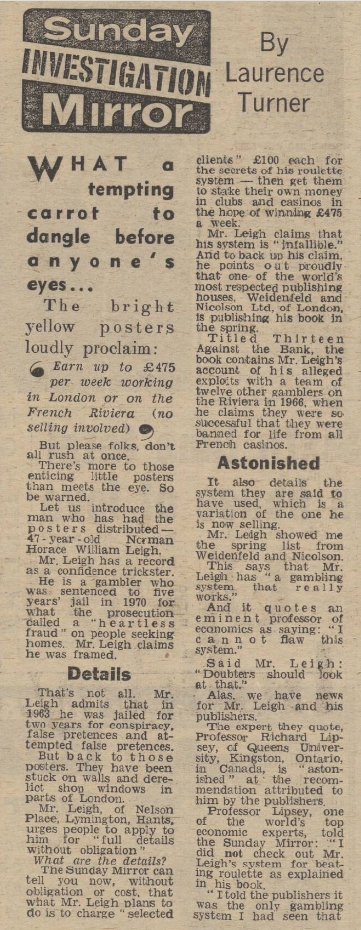
Thirteen Against The Bank by Norman Leigh

Whilst the main events of the story did indeed take place, despite being a fairly enjoyable read I think it comes closer to an adventure from the Enid Blyton stable than being a "true and detailed account" of what actually happened - some aspects seem suspiciously detailed considering they were written about so much later.
New Milton Advertiser - Saturday 24 January 1976Not a good weekend for Norman LeighLast weekend was not a very good one for Mr. Norman Horace William Leigh (47), of 11, Nelson Place, Lymington.The "Sunday Mirror" published an investigation into his activities, and on Monday he appeared at Lymington Magistrates' Court where he was fined £10 for being drunk and disorderly the day before in the High Street and Captain's Row,The "Sunday Mirror" article dealt with an investigation into Mr. Leigh's past, and his offer to the public suggesting they could earn large sums if they bought his infallible gambling system. His posters read: "Earn up to £475 a week working in London or on the French Riviera (no selling involved). Full details without obligation".For only £100 plus 25 per cent of the winnings, Mr. Leigh will sell the secret of his roulette system. He said his plan was to recruit 100 people to play the roulette tables as individuals at clubs in London and on the French Riviera. "By working inconspicuously at roulette four hours a day, for five days a week, 100 people could gross £50.000 a week of which, by contract, my share would be £12,500." he told Lawrence Turner, who did the investigation.In case anyone might be anxious to try their luck, the "Sunday Mirror" also revealed that Mr. Leigh has a record as a confidence trickster, and was sentenced to five years in jail in 1970 for what the prosecution called "a heartless fraud on people seeking homes." Mr. Leigh claims he was framed.
Never having succeeded, he convinced himself of the validity of a theory published in 1923 by the Hon.S.R.Beresford, third son of the third Baron Decies, that the reason people lost so much playing roulette was less about the impact of the house edge and more about the consequence of increasing bets when losing and chasing losses.
Following on from this he adopted the Honourable Mr B's suggested "system", which takes the already known Labouchere negative progression system (one where you bet more when losing to recover losses), and simply reverses the staking plan to arrive at the Reverse Labouchere - bets would be progressively increased as successive wins occurred, but remained constant when they didn't.
The premise of this unbeatable system seems to be based on the chance that streaks of continuous winning results will occur often enough, and continue for long enough to reach the table limit, to generate sufficient winnings to offset the losses resulting from the zero being spun and the house edge biting.
Some have suggested that perhaps mathematics may not have been the author's strong point, although I'm not so sure. In his story he contributed none of his own capital to the enterprise and all of his team were required to pay all of their own travel and accommodation expenses, and provide a minimum amount of £250 stake money (the equivalent of £4,200 today) in order to apply his system in France - he carried no financial risk, apart from his own travel and accommodation expenses, and made his money by taking 10% of any winnings.

I suppose a question is could the Reverse Labouchere be applied today, on the prospect of just getting lucky. Sure, and you might just be so. But as casinos nowadays have a five or ten times table minimum bet requirement on evens-payout options, and maximums of 500 or 1000 times table minimum, the scope for recouping sustained losses from progressing to the table limit is fairly limited over what it may have been in the past. You could reduce the exposure by betting 6 lines (6 lots of 6 numbers, so all of them bar the zero) at the table minimum with a co-player, which would mean betting 6 units per spin rather than 20 but achieving the same coverage and providing some el-cheapo entertainment into the bargain. It might be fun, but don't be under any illusions that the longer term prospects for this system lead South. Accurate and comprehensive record keeping will expose it's fallibility.
After reading the book, I did wonder what became of Norman Leigh? Half an hour searching the web provided the answer; I came across some postings from someone who knew and had played roulette with him together with two entries on the Amazon review page for Thirteen against the Bank from his niece and his ex-wife, Pauline.

Thirteen against the Bank was reprinted in 2006 and remains available from all major book retailers.
November 2014
Postscript
Shortly after I finished reading Thirteen against the Bank I wrote to Pauline, Norman Leigh's ex-wife, and she kindly agreed to meet me and answer some questions . . .
Q. Was the team really made up of an Etonian, a publican, an ex-copper, a glamorous mum, an elderly widow etc? Can you recall the backgrounds of the team members you met?
A. I think the characters portrayed in the book are a fairly accurate reflection of the team's mix. The Etonian, named as "Blake" in the book, who acted as Norman's second, was actually a stockbroker. All of the characters' names have been changed of course, and I think it would be indiscreet of me to name them.
Q. Was the team's barring from the Casino Municipale in Nice carried out in the respectful manner described in the book, or was it simply a case of them being turned away at the door one day with no reason being given? Are you able to elaborate?
A. I don't know as I didn't join the team until after they had been barred from playing at the Casino Municipale in Nice.
Q. At what point did the French police become involved (if at all) and to what extent?
A. Again, I don't know. The team certainly wasn't ejected from the Country, as after I joined them we stayed in France for a further three weeks and returned home voluntarily (and broke).
Q. After the team's members were barred, did you all travel to any other casinos in France to try your luck?
Yes. By the time I joined the team they were already playing at the Casino du Palais de la Mediterranee, which is also in Nice.
Q. Do you know how much money was actually won or lost on the trip - for Norman and the individual team members?
A. No. I became aware that things weren't going too well when the letters Norman had been sending home, that contained French banknotes, dried up and the amount of money we had to pay for our stay in France dwindled; we went from enjoying three meals a day to having just one. Eventually, after three weeks, a meeting of the team was called to decide whether to continue or not. Norman was all for carrying on, but the majority voted not to and to return home. I recall that towards the end of the discussions "Blake" turned to Norman and said, "Mr Leigh, you are a dreamer and your wife is a realist!".
Norman and I travelled back to England, all the way through France, by train on third class rail tickets. Some members of the team, who were staying in better hotels and were not short of funds, opted to stay.
Q. Your father gets a mention in the book, and Norman describes him as "old school" when meeting him for the first time. What was his reaction to the plan to travel to France to break the bank at roulette?
A. If I recall rightly he was calm and uncommitted when I told him of the plan, and said something along the lines of "if that's what you want to do, good luck".
Q. After returning to the UK, were there any plans for the team to continue playing together in casinos in Britain?
A. No. I'm pretty sure that those members of the team who returned home had all lost money.
Q. Did you and/or Norman ever meet up with any of the team members after the return from France?
A. Just once. Norman and I met up with one couple for dinner, but that was the only time.
Q. Did Norman subsequently continue to play roulette and plan around "beating the wheel"?
A. I'm sure he did. He always had one scheme or another in hand, including selling "winning systems".
Q. In the book's foreword, Norman admits to having been convicted on a fraud charge in 1968 and of serving time as a result (although he doesn't state how long). Is this something that happened whilst you were still together? If so, would you be willing to share the details?
A. I'm afraid I can't recall the circumstances of the case or the charges. Around that time we had to give up our house in Twickenham. I'd foolishly allowed him to use my name on some HP agreements, and shortly after that he was convicted and accommodated by Her Majesty's Prison Service. I know he was sent to prison on more than one occasion and was made bankrupt.
Q. Are you able to provide any details of Norman's fortunes after your separation and divorce?
A. After we separated I returned to the Isle of Wight and Norman was convicted. Our divorce formalities took longer to conclude than they needed to as a result of Norman making difficulties from prison. After he was released, he did contact me and ask if I could help him out with some money, but I declined - during our marriage, all of my savings and a bequest from an Aunt were used up supporting his schemes.
Before we were married, Norman had worked as an Insurance Agent for a short time, but resigned due to a dispute over sales and withheld commissions, and I think that was the last time he ever had a real job. Norman did come and meet our son, Julian, and a vague contact ensued until the time of Norman's death - which Julian found out about through seeing a local press headline on a newsagent's billboard.
Norman's last address was a room at the Catisfield Hotel in Fareham, which to all intents and purposes was a DSS hostel. After his death I was contacted and asked if I would go there and clear out his effects, which I did. He didn't have much and was given a pauper's funeral.
Norman's estate is still managed by an agent, and the TV and film rights to his book are renewed by a production company every two years.
Many thanks to Pauline for indulging my curiosity.

Further reading: https://rss.onlinelibrary.wiley.com/doi/full/10.1111/j.1740-9713.2018.01211.x
Based on our simulations, we conclude that the book Thirteen Against the Bank by Norman Leigh is a work of fiction – which is a shame as it is a very nice story – and that the system it describes cannot, and does not, consistently return a profit. Our future work will include simulating other betting systems, including those of the game of blackjack, so that the scientific archive, and the general public, have a point of reference for systems which claim to “break the bank”.
Thursday, 1 February 2001
Ron Pollard
From the Daily Telegraph's Obituary pages, 5 July 2015:
Ron Pollard, who has died aged 89, changed the face of British betting by taking the bookmaking business beyond horse and greyhound racing into the more exotic arenas of beauty contests, politics, book prizes and the arrival of aliens from outer space.
Guided by his principle that “betting should be fun”, Pollard’s genius was to realise that many punters would cheerfully bet on outcomes far less likely than their being struck by lightning. “It was abundantly clear”, he once said, “that the public would gamble on absolutely anything. If it moved, if it was on TV, if it caused an argument in a pub, they wanted to bet on it.”
His aim was always for his firm, Ladbrokes, to be first with anything new, thus raising its profile and encouraging more punters to use it. Having introduced betting on cricket, golf, tennis, darts and snooker, in 1977 Pollard offered odds on the existence of the Loch Ness Monster; in the same year Ladbrokes started to take bets on the arrival of aliens on Earth, giving 500-1 to a group in California run by a woman who claimed to be a reincarnation of the Mona Lisa.
Pollard offered odds of 1,000-1 against Elvis Presley returning from the dead. Although he conceded that this was a “tasteless exercise”, Ladbrokes took so much business that it soon had a £2·5 million liability, and he had to cut the price to 100-1. The safest bet he ever laid was placed by a teenage girl: 5,000-1 against her taking tea with a reincarnated Elvis by the end of 1982.
Although these stunts were not always profitable – Ladbrokes had offered 100-1 against a man walking on the moon in the 1960s – he appreciated that they reaped for his firm “the most precious commodity of all: publicity”.
Pollard did not attribute his success entirely to his own acumen. He was a self-confessed spiritualist who believed that he was guided by a 15th-century bearded Chinaman in a white skull-cap. His interest in this field had been aroused in 1955 when, aged 29, he accompanied his mother-in-law to Kennards, a department store in Croydon, where she consulted a medium.
Although then a sceptic, Pollard also saw the medium, who caressed the young man’s comb before pronouncing: “Goodness gracious, I wish I was going to have your life. You are going to be in all the papers, everyone wants to know what you are saying, and you are going to Buckingham Palace [to] meet members of the Royal Family.” It was she who alerted him to the presence of his Chinaman. Twenty-four years lat er Pollard was honoured as “Spiritualist of the Year”.
His greatest coup came in 1963, when he introduced betting on politics with the “Tory Leadership Stakes”: “For two weeks I did not know if I was a bookmaker or a film star. The telephone did not stop ringing. I was constantly on television and radio. Everyone wanted a quote.” Sir Alec Douglas-Home (the eventual winner, who had initially ruled himself out of the contest) was installed at 16-1; Ladbrokes took £14,000 on the exercise, making a profit of only £1,400. But the company was now known across the world.
At the next general election, in 1964, Ladbrokes opened a book. The hotelier Maxwell Joseph bet £50,000 on a Labour victory, winning £32,272 when Harold Wilson emerged with a five-seat majority. Had the Tories won, the firm would have lost £1·5 million — money it did not have. Pollard was so concerned about this outcome that he resolved to commit suicide in the event of a Conservative victory.
The £640,000 that Ladbrokes took on that election was the record at the time for any single event (including the Derby or the Grand National). In the general election of 1966 the firm took £1.6 million.
Before long, Pollard was being entertained by MPs at the House of Commons. At the time of the Conservative Party’s leadership election of 1975 he was invited to lunch at White’s, where someone inquired what odds he was offering on Margaret Thatcher to win the Tory leadership. Pollard replied: “Fifty to one.” Pollard’s companion confided: “I would be very careful if I were you.” The odds were immediately slashed to 20-1.
Occasionally, Pollard’s political antennae (or his Chinaman) let him down, as in the general election of 1970, which the Conservatives unexpectedly won, costing Ladbrokes around £80,000. Some members of the board wanted Pollard sacked; but the chairman, Cyril Stein, remained loyal, telling his colleagues: “If he goes, I go.” The odds-maker survived.
Ronald James Joseph Pollard was born in London on June 6 1926. His paternal grandfather distributed relief money to the unemployed, and would visit pubs in Southwark disguised as a chimney sweep to see if any of his clients were spending their welfare on beer. Although Ron’s father was the accountant to a mineral water company, the family had little money and his mother worked from home as a glove machinist. At school in Peckham Ron failed to shine academically but enjoyed playing football and cricket. He left with no qualifications.
He got a job as an office boy in a building firm at Peckham, learning bookkeeping. On Saturdays he went greyhound racing at Catford. Then, in 1943, he became a ledger clerk with William Hill at the bookmaker’s office in Park Lane. At first he ran errands, such as paying a jockey who had obligingly finished second on a hot favourite at Goodwood. At this stage Hill’s was operating illegally by handling cash betting, which was then allowed only on the racecourse (transactions off-course had to be on a credit basis).
Although he was called up for the Army, Private Pollard was still at Westcliff-on-Sea on VE Day. He then served on the Gold Coast, where he was promoted to sergeant and won the Gold Coast ping-pong championship two years in succession.
He returned to Britain in 1947, and was demobbed the following year, returning to work for William Hill. He was made a course clerk, recording the bets taken by the Hill’s representative, and occasionally acting as the bookmaker at some of the smaller meetings; he was then appointed manager of the accounts department.
Pollard joined Ladbrokes as credit manager in 1962, the year the firm opened its first betting shops. “These were still the days of credit betting, and you had an account with Ladbrokes at their Burlington Street offices only if you were in Debrett,” he said. “If you were in trade, no matter how prosperous, you had no chance of an account with the firm that had a direct telephone link to Buckingham Palace for the regular royal bets that would be struck, sometimes daily.”
Before long he had been appointed general manager of Ladbrokes, and, in 1964, he was made a director of Town and Country Betting, the Ladbrokes holding company which was to become Ladbroke Racing. In the same year he became the firm’s PR director, remaining there until his retirement in 1989.
Among Pollard’s most famous stunts were his forays into the Miss World contest. These did not endear him to the organisers, Eric and Julia Morley. After Julia Morley accused him, apparently without irony, of “dragging [the contest] into the cattle market”, and banned him from the Miss World rehearsals in a television studio, Pollard disguised himself as a carpenter (complete with overalls, cloth cap and a tool kit) and spent a morning assessing the attributes of the candidates on whom he was to make a book.
On another occasion he assumed the character of a waiter, sporting a false grey moustache, to penetrate the dining room at the Dorchester where the finalists were attending a function. Pollard was extremely successful in predicting the outcomes of Miss World, and in 1982 personally won £5,000 when Miss Dominican Republic took the title. His guiding principle was: “The sexy ones never win.”
When it came to fixing odds for the Booker Prize, Pollard would read the first 60 or so pages of a novel; a similar number in the middle; and the final 60.
Pollard himself was not a habitual gambler (betting “only when I thought I knew something”) and did not have a high opinion of those who were: “The reason why people bet has nothing to do with money. They do it because they want to get one up on the other fellow and because they want to be right.”
He was an entertaining man and a fine raconteur who courted, and made many friends among, the press. A lifelong socialist, his greatest regret was that he never became an MP; he claimed to have been offered a seat by all three main parties.
In 1991 he published an autobiography, Odds & Sods: my life in the betting business.
Ron Pollard is survived by his wife, Pat, and three children.
Ron Pollard, born June 6 1926, died June 10 2015
Navinder Singh Sarao – The Hound of Hounslow
It took Navinder Singh Sarao a long time to accept that he might have been scammed out of $50 million. Stuck in London’s Wandsworth prison, wracked with anxiety and unable to sleep, the realization dawned on the man dubbed the “Flash Crash Trader” as slowly as spring turned to summer outside the barred window of his jail cell.
The trauma of the past few weeks had been difficult to process. On April 20, 2015, the slight, doe-eyed 36-year-old had dozed off peacefully in the same suburban bedroom he’d slept in since he was a boy. The next day he was arrested and taken to a police station, where he was charged with 22 counts of fraud and market manipulation carrying a maximum sentence of 380 years.
According to the U.S. government, the British day trader had made tens of millions of dollars using an illegal practice called spoofing, including, fatefully, on the morning of May 6, 2010, when the Dow Jones Industrial Average fell almost 1,000 points in minutes before bouncing back. The extent of Sarao’s culpability for the flash crash is fiercely contested, but the incident exposed the shaky foundations on which the hyper-fast, computer-dominated financial markets now rest.
Sarao’s bail was set at 5.05 million pounds ($6.3 million). It was a hefty sum, but according to the accounts of his company, Nav Sarao Futures Limited, he’d earned 30 million pounds in the previous five years. Newspaper reports, in which Sarao was dubbed “The Hound of Hounslow,” speculated that he’d be back with his family in the shabby West London borough by the weekend.
Where’s the money, Nav, his lawyers wanted to know. Sarao couldn’t make bail, they gradually learned, because the bulk of his wealth was tied up in investments and offshore trusts, each more complicated than the last. Days in Wandsworth prison, a Victorian-era fortress where Sarao was housed with sexual predators and violent offenders, turned into weeks.
After four months of dead ends, his legal team struck a deal with the authorities: If the U.S. Justice Department and the Commodity Futures Trading Commission agreed not to oppose a reduction in bail to 50,000 pounds, the firm would act as a bounty hunter, taking on responsibility for tracking down the missing millions on the condition that its fees be paid if it did.
They were going down a rabbit hole. A review of Sarao’s investments from 2005 to the present day, based on dozens of interviews and thousands of pages of documents, reveals another twist in an already remarkable story.
Sarao declined to comment for this article. His lawyer, Roger Burlingame of Kobre & Kim in London, told a U.S. judge in November that all of the defendant’s assets “have been stolen.” Sarao invested in ventures from which he, the law firm and the CFTC had been unable to recover the funds, Burlingame said. “Basically, he has some extraordinary abilities with respect to pattern recognition and certain sorts of mathematical abilities, but he has some fairly severe social limitations.”
Sarao’s trading career started inauspiciously in 2002 at Futex, a fledgling outfit in an unglamorous office an hour from the City of London that housed wannabe traders in exchange for as much as 50 percent of their profit. In a roomful of recent college graduates and drifters, Sarao stood out from the pack.
“Nav was always going to be the kind of person that would be legendary in some way,” Futex Chairman Paolo Rossi said in an interview with Bloomberg TV after Sarao’s arrest. He had “the potential to be remembered as one of the world’s greatest traders.”
It wasn’t until Sarao left Futex in 2008 and struck out on his own that he started to make serious money. Public filings show his assets popped to 14.9 million pounds from 461,000 pounds in the 12 months ending in June 2009, long before he enlisted a programmer to build a system that authorities say was designed to cheat the market.
Former colleagues talk about Sarao’s frugality—his scruffy clothes, his reluctance to spend money on cars and watches, his abstemious eating habits. He learned early at Futex that withdrawing cash ate into his bankroll and reduced the size of trades he could place.
That near-obsessive drive to hold on to as much of his wealth as possible can also be seen in the way he conducted his business affairs. Looking to minimize his tax bill, he was introduced by his accountant to John Dupont, a director at the London arm of an Isle of Man-based financial advisory firm called Montpelier Tax Consultants.
Dupont, then in his mid-30s, was a high-energy salesman whose accent veered from upper class gent to Guy Ritchie cockney depending on who he was speaking with, a former employee recalls. Operating from an office on Cockspur Street in London’s West End, members of his team cold-called contractors, day traders and bankers and tried to enlist them in a range of plans to minimize their tax bills, documents seen by Bloomberg show.
The aim was to identify loopholes before they were closed. One former Montpelier employee said he coaxed wavering customers to sign up by promising to pay their legal bills in the event of a clampdown by Her Majesty’s Revenue and Customs. Everyone at the firm thought he was Alec Baldwin in “Glengarry Glen Ross,” the person said.
Self-employed traders were particularly good prospects because they were predisposed to high levels of risk. And Sarao, an absent-minded dreamer with an unerring gift for making money who would later be diagnosed with Asperger syndrome, would prove to be the ultimate mark.
In 2009, on the advice of Montpelier, Sarao entered into a complicated dividend-stripping scheme that resulted in a major reduction in his tax bill, according to a close adviser to Sarao who spoke on the condition of anonymity. Happy with the result, Sarao went a step further the following year, the person said.
Among Dupont’s crew was Miles MacKinnon, a polished so-called introducer who had left school for a stint as a rugby player before heading to the City of London. For four months in 2010, MacKinnon became the only other director of Sarao’s firm.
Around the same time, Sarao set up two employee benefit trusts in the Caribbean island of Nevis, according to a document filed in Sarao’s case. He plowed his earnings into those trusts, then gave himself interest-free loans to trade with and live on, the adviser said. The arrangement meant Sarao all but avoided paying corporate taxes. One vehicle was named the “NAV Sarao Milking Markets Fund.”
Dupont and MacKinnon said in an e-mail that they “did not introduce or advise” on the Nevis trusts.
Sarao had an uncanny ability to attract controversial characters. He sought advice from tax specialist Andrew Thornhill, who in 2015 would be charged by the British barristers’ industry group with five counts of professional misconduct. And, as the Wall Street Journal reported, one of Sarao’s trusts was, for a period, affiliated with David Cosgrove, the Irish director of Belvedere Management who has been barred by Mauritius authorities from serving as a company officer because of regulatory violations. Thornhill declined to comment. Cosgrove didn’t respond to e-mails.
In 2011, the British government ended the benefit-trust gravy train. Sarao paid back the loans and restructured his business. Montpelier was investigated and dissolved, and about 3,000 of its customers were ordered by a judge to pay 200 million pounds in back taxes. Fraud charges against two directors were later dropped.
MacKinnon and Dupont—along with a third partner, Ryan Morgan—then founded MacKinnon Dupont Morgan, which was later reborn as MD Capital Partners. The firm describes itself on its website as a boutique private equity firm.
They leased an office in Mayfair, home of hedge funds, Michelin-starred restaurants and private members clubs. MacKinnon joined the Worshipful Company of International Bankers and the executive board of the Special Olympics. He and Dupont set up about a dozen companies between them, focusing on industries such as renewable energy.
Dupont and MacKinnon said in their e-mail to Bloomberg that they “never made, or introduced investments to projects that are purely driven by tax breaks” and that at the time they got involved in renewables there weren’t any tax incentives in place. Morgan, who left the firm, didn’t respond to a request for comment.
By 2011, Sarao had trebled his assets to 42.5 million pounds. He agreed to become an investor in an Isle of Man-based entity called Cranwood Holdings, set up to acquire land in Scotland that would one day house wind farms, according to two advisers to Sarao. Documents on the enterprise filed in the British dependency are light on detail, but the advisers say Sarao put about 12 million pounds in Cranwood—money they say Dupont and MacKinnon could access.
Dupont and MacKinnon said in their e-mail that Sarao conducted “substantial independent due diligence” before investing in Cranwood and that he approved all of its payments. One of their companies, Wind Energy Scotland, is funded by and provides project management services to Cranwood.
The pair also acted as agents for more exotic ventures, such as sending divers to search shipwrecks for sunken treasure. The returns on offer were never less than impressive. Sarao, who told acquaintances he harbored aspirations of becoming a billionaire, invested in several. All were tame compared with what came next.
Sometime in 2012, Sarao was introduced—again through Dupont and MacKinnon—to a squat, intense Mexican named Jesus Alejandro Garcia Alvarez, who was looking for investors for his company IXE Group. Garcia said he was the scion of a family of billionaire landowners and industrial-scale farmers with swaths of land around the world. He had arrived in Zurich from Latin America a few years earlier and had been working hard to build a reputation ever since.
IXE was conceived as a one-stop shop for high-net-worth individuals, offering services ranging from asset management to event planning to advice on private schools. Then, around the time Sarao met Garcia, the company’s website underwent a radical overhaul. Gone were the concierge services. IXE was henceforth a “conglomerate of companies worldwide” involved in “agribusiness, wealth management, commodity trading and venture capital.”
Articles appeared in the Swiss media profiling the mysterious young man making waves among Zurich’s business elite, including pictures of Garcia wearing a poncho over his suit, arm outstretched across Bolivian salt plains he said he owned. One newspaper put him on its annual rich list. Garcia was invited on Bloomberg TV to talk about his family’s quinoa interests, then on CNBC to discuss the “white gold rush” for lithium.
Garcia had all the trappings of a successful entrepreneur: half a dozen sports cars, a small but well-appointed office in the center of Zurich, a glamorous Russian wife. He even joined the Swiss board of the Robert F. Kennedy Center for Justice & Human Rights, an organization whose U.S. directors include Tim Cook and Martin Sheen.
Garcia flew to London and met with Sarao two or three times, according to people with knowledge of the matter. In an interview on IXE’s website, Garcia laid out his pitch to investors: “We are offering alternative investment vehicles that provide constant returns to investors. The investment in real economy makes the advantages obvious—investors are benefiting from constant returns generated from actual transactions with zero speculation and zero volatility.”
Garcia told Sarao he would get an annual 11 percent return, the people said, and assured Sarao that any money he handed over would be used only as collateral, not put at risk. He also introduced Sarao to Swiss banking contacts, they said. The trader was again restructuring his business, this time around an Anguilla-based vehicle called International Guarantee Corporation.
Sarao did some due diligence about IXE, according to one adviser, but he seems to have overlooked a few red flags: The company website is littered with spelling mistakes, and several executives are members of Garcia’s family.
Garcia initially agreed to meet to discuss this story, then opted to respond to questions through a colleague at IXE. The colleague, Dominic Forcucci, wrote in an e-mail that Garcia hadn’t done anything improper and that IXE “properly disclosed the risks of investments” to Sarao. A lawyer representing Garcia, William Wachtel, later said that Garcia described any allegations against him as “baseless and without merit.”
On Aug. 20, 2012, documents show, Sarao agreed to give about $17 million to Garcia and his company—by far his biggest investment and a substantial chunk of his net worth. He later invested an additional $15 million, according to a person with knowledge of the matter. Even though they’d met on only a handful of occasions, he would describe Garcia to associates as a friend.
Sarao may have been particularly trusting, but he wasn’t alone in buying into the IXE miracle. Former employees interviewed by Bloomberg describe Garcia as charming and, on first meeting, impressive. He offered commissions to third-party agents to send prospective investors his way, ensuring a steady stream of business and creating a buzz around the firm.
In 2014, Garcia signed a deal to acquire Banca Arner, a Swiss lender in decline after allegations that it had helped former Italian Prime Minister Silvio Berlusconi hide money. To coincide with the transaction, Arner’s new marketing chief, Garcia’s wife Ekaterina, issued a press release announcing it had appointed a new chairman: Michael Baer, a great grandson of the founder of private bank Julius Baer Group and a respected figure in Swiss banking.
IXE just needed sign-off by Switzerland’s financial regulator, Finma. In order to seal the deal, Finma told Garcia he’d have to come up with 20 million Swiss francs ($18.7 million) in capital and account for where it came from. After heated meetings with the regulator and the owners of Arner, Garcia offered to hand over the money in unmarked gold, according to two people with knowledge of the talks. Without a stamp, the gold was unacceptable to the regulator, and in the end Garcia walked away from the deal, leaving Baer and a raft of other new recruits frustrated and embarrassed, the people said. Baer and a spokesman for Finma declined to comment.
For the time being, though, Sarao had no cause for concern. IXE sent him periodic statements showing the interest accruing in his accounts. As ever, he was happy to let it sit there and grow.
By then, Sarao’s readiness to consider almost any opportunity that offered an attractive rate of return was well-established. After another strong year in 2013, Dupont and MacKinnon introduced him to Damien O’Brien, a physically imposing Irish entrepreneur with aspirations to revolutionize the online-gaming industry.
The unique selling point of O’Brien’s company, Iconic Worldwide Gaming, according to a pitch document seen by Bloomberg, was that it allowed gamblers to bet on movements in currencies and securities using an interface that looked like an online casino, with a roulette wheel and buttons for “higher” and “lower” instead of red and black. The patented software was called MINDGames, short for Market Influenced Number Determination games.
The concept may not have pleased Gamblers Anonymous, but the financial projections were enticing. O’Brien predicted in the pitch document that Iconic would go from a standing start to a cash balance of 110 million pounds by the end of its third year. There were also some reassuring names on the board: Robin Jacob, a U.K. appeals court judge, and David Michels, a former deputy chairman of Marks & Spencer.
In July 2014, documents show, Sarao invested 2.2 million pounds in Iconic. Cranwood Holdings extended loans of an additional 1 million pounds, according to one Sarao adviser. He was, several times over, the largest investor in the company.
Dupont and MacKinnon said in their e-mail that Sarao was an experienced gambler and trader who conducted his own due diligence on the gaming sector before investing. They also said they objected when Sarao told them he planned to lend money to Iconic. O’Brien didn’t respond to requests for comment. Jacob and Michels said they were no longer board members.
In the months following Sarao’s investment, O’Brien went on a campaign to increase Iconic’s profile. The company sponsored World Touring Car Championship driver Rob Huff and filmed a slick advertisement with mixed martial arts superstar Conor McGregor. O’Brien and his employees were photographed ringside or wining and dining clients. In one shot taken in Las Vegas and posted on Twitter, a line of promo girls posed in matching uniforms with Iconic logos emblazoned on their hot pants. In another, O’Brien stood next to a matte-black Rolls-Royce with the license plate DAMI3N.
By the time Sarao was arrested in April 2015, he had about $50 million tied up in investments around the world, according to people with knowledge of the matter who even now aren’t positive it’s all accounted for. It was only as his lawyers tried to recoup the money that he was forced to face up to the possibility that it was gone. Sarao was released that August after his parents put up the family home as collateral against the bail of 50,000 pounds.
In November of last year, following an unsuccessful extradition fight, Sarao flew to Chicago where he pleaded guilty to one count of wire fraud and one of spoofing, which entails placing bids or offers with the intention of canceling them before they’re executed. He was ordered to pay $38.4 million to the CFTC and the Justice Department, which determined that, of the money he made by day trading, only $12.8 million came from cheating the market.
Sarao is scheduled to find out the length of any custodial sentence later this year. In the meantime, he has been allowed to return to Hounslow, where he is banned from trading and, despite pushing 40, placed under the care of his father.
Sarao’s lawyers are no closer to getting their hands on the money beyond about 5 million pounds seized from his trading accounts after his arrest. The CFTC and the Justice Department have joined them in the hunt, according to people close to the situation. The agencies could try to compel banks holding Sarao’s assets to give them up, but that might not be easy because most of the money is outside the U.S. Spokesmen for the CFTC and the Justice Department declined to comment, as did Burlingame, a former Justice Department prosecutor who represents U.K. targets in U.S. investigations.
IXE told Sarao it would return the cash in instalments in 2015 and 2016, according to a person familiar with the matter. The deadlines came and went, but no money has been produced. Garcia is rarely seen driving his sports cars around Zurich anymore, according to former associates. In October, German magazine Brand Eins skewered what it portrayed as his outlandish claims about plots of land in Bolivia and Mexico and linked Garcia to Burton Greenberg, who’s serving eight years in a Florida prison for fraud.
Former IXE employees interviewed by Bloomberg say that Garcia spent whatever he brought in to fund his own lavish lifestyle and that projections he gave in presentations to Sarao, Baer and others were plucked out of thin air. Still, Garcia’s efforts to acquire a bank continue. In August, IXE announced it was buying Private Investment Bank in the Bahamas from Swiss firm Banque Cramer & Cie. The deal is scheduled to be completed this month.
Garcia hasn’t been accused of any wrongdoing. Forcucci, the IXE spokesman, said the company is “working to return the money in a fair and equitable manner to its investors.”
Iconic went into liquidation in January 2016. A company hired to advise it on resale options said O’Brien had underestimated the cost of breaking into the online gaming market by about 10 million pounds.
Sarao’s lawyers have been unable to retrieve his investments in Cranwood despite repeated requests, owing to its convoluted offshore ownership structure, according to a person with knowledge of the situation. Dupont and MacKinnon said in their e-mail that Wind Energy Scotland has been working to get funds to Cranwood.
From their base in Berkeley Square, the pair last year started another company focused on renewable energy, Celtic Asset Management, which offers “access to a substantially higher return profile, with less capital at risk.”
Meanwhile, Sarao is back in his bedroom. The computer that got him into so much trouble is gathering dust in a Washington evidence room. Depending on how much the authorities are able to recoup, he will probably spend the rest of his life paying back the money he owes. If they really want it, they could always lift the trading ban, one associate quips: He’d make it back in no time.