Friday, 2 September 2022

Smokey The Square

As some of you may have seen, I recently spotted a Tweet containing what I was fairly sure was some rather poor advice. 


We all make mistakes, so I didn't reveal the account name, but after pointing out the inaccuracy of the Tweet, rather than simply admit he was wrong, the person in question gave some responses that made absolutely no sense, before later deleting his nonsense. 

He appears to be fairly new to betting, and the handle SmokeytheSharp can only be an ironic nickname in the same category as nicknaming a morbidly obese guy "Tiny". 

Fortunately he has very few followers, so feel free to become the 168th if you'd like, though I wouldn't recommend it.
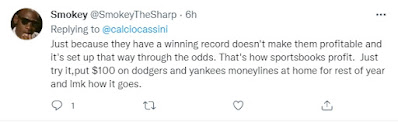
The Tweet in question stated, with no qualifications:
Saying 'never' is rarely a good idea, but the idea that big teams might be over-bet and that there thus might be value in opposing them isn't new, and it's an angle I've looked at in some detail. 

Ignoring the fact that "in the long run" you will either be up or down overall, and will almost certainly not ALWAYS lose, I quite politely pointed out that:
This is very poor advice.

With almost 19 seasons of data, blindly backing the Los Angeles Dodgers when favourite has a positive ROI from more than 2200 matches.

If the 'tip' had specified 'Away / Road favourites' it would have had some merit (the Yankees are actually the worst team to back in this situation), but at home, these two clubs are actually the best of the 30 clubs to back when favourites.

When faced with these facts, the first response was this:

Who said anything about "winning records"? My response clearly referenced ROI so again, I very politely suggested that Smokey:
I should have said "are positive" but as I said, we all make mistakes. The response this time made it quite apparent that we were dealing with SmokeytheSquare:
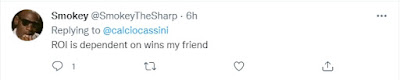
What?! Presumably he later realised the error, and it's no wonder he deleted his Tweets. 

Obviously this is complete nonsense as I, again, patiently and politely pointed out, even taking the time to include an easy example:
Our friend then tried a different tactic, the old trick of moving the goalposts, writing:
But I thought the original Tweet clearly talked about the long run? No, apparently we're not talking about the long run at all, but we're talking about 'now', which of course is a term that needed some clarification. Is it a Day? Week? Month? Season? 

The answer is that, for Smokey, the 'long run' is a season. It's probably not the definition most readers will have of a 'long run', but so be it. 

How true was the statement that if you bet both those teams consistently [to level stakes] you'll lose over a season?

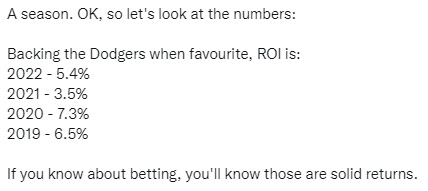
Not very. Profitable each of the last four seasons:

The response? To delete all the Tweets, although at the time of writing the original one is still there.

As for the other two "tips"?

Number 1 makes sense. Squares tend to like Home teams and winning teams, so if there is any value, the first place to look would be Away teams with losing records. 

And in fact, there is value on these teams when they are favourites and have won their previous game. The market likes the team, hence they are favourites, yet still undervalues them. If you look at games where such a team has won their last two games, the ROI is even better (4.1% on the Run Line since 2004). 

"Rule" number two is good advice except for games when the pitcher is from the American League playing an inter-league game. In this situation, the ROI is 5.3% since 2004, so again, never say never. 

Until this season, ERAs across leagues cannot, and should not be directly compared due to the different rules in place, but that will probably change. 

Unfortunately, of his 167 followers, it's highly probable that the vast majority do not validate these claims for themselves. It could be costing them money. 

Apparently the account is going "private" for the NFL season in a few days time, but the evidence suggests the guy has no edge and frankly, little idea about how sports betting works. 

One big clue is that there is no record keeping. There are a few green ticks for some winners, some red crosses for some losers, but the majority have nothing next to them at all. 

Make of that what you will, but importantly there is no running total, and no way of verifying whether a follower would be "in the can" or green all over.

This lack of verifiability was the reason I stopped discussing the Bundeslayga System on this blog, (it requires a lay price and being Exchange bets, an accurate historical record is not readily available), but after corresponding with my old friend Stewboss, I may have an acceptable compromise and in a few days plan to add it to the "Sacred Document". 

If you signed up, "stand back, and stand by" as someone once said.

One of the intentions of this blog is to educate people into not believing everything they read and to verify claims such as the ones made by Smokey. Unfortunately there are a lot of Smokeys out there but it's not necessarily all bad. Claims such as his can be easily verified and this process may well lead to discovering an angle that you hadn't previously considered. 

Rufus, Hedging, and Oxford Coma

This blog doesn't get too many comments, so it was rather remiss of me not to mention one from Jason regarding my Risk Is Personal post a few days ago.


Jason wrote:
Hi Cassini, This (very loosely) reminded me of a podcast I listened to recently, on the subject of hedging. Not sure if you're a listener to the Bet The Process podcast, but within the last couple of months (Season 5 Episode 32) there was a discussion on whether to hedge out of a bet even if the hedge itself is a bad value bet. At around 25 minutes in the discussion covers the use of Kelly in relation to hedging out of a bet, even at a negative edge, when considering what you stand to win in relation to your bankroll/personal wealth. I can't really comment on the maths (although I'm sure you can), but thought it might be of interest when considering the follow-up poll referenced in your piece (where the responders are asked to consider the effect of net worth on their choice between red and green). Hope this is of some interest to you. All the best, Jason

I found the podcast in question, and it's well worth a listen. Tying a couple of former posts together, and I mentioned here that my 100 miles every month goal was in jeopardy. 

Additionally, and while less of a factor than calories ingested, my exercise routine has also been significantly disrupted and my monthly goal of 100 miles on foot is in serious danger of being missed for the first time since November's feeble 93 miles.

Fortunately listening to podcasts is a great way to pass the time and learn something new, and I ended up at 115.9 miles with one of those hours spent listening to Rufus and Jeff discussing hedging and Kelly as Jason describes.

Rufus Peabody is a betting person I respect a lot, and I've mentioned him several times in this blog, including recommending a podcast he did for Pinnacle Sports a little over three years ago. He also led me to the excellent book The Logic of Sports Betting by Ed Miller and Matthew Davidow which you should definitely read if you are serious about being profitable in sports betting. 

Back to hedging out of a bet, even at negative value, the premise was this. You make a bet at fairly long odds, and are lucky enough to find yourself in a very good position. 

I thought I'd written about this before using the example of backing a small team to win the FA Cup pre-season (say Oxford United), going into a coma, before awakening on the eve of the Cup Final to find that they are playing Crystal Palace. (One can dream). 

The £100 bet was placed at 1000-1, and Oxford are now available at 2.75 to lift the Cup. Palace are just 1.35 to win their first proper major trophy, but their fair odds are really more like 1.5.

The question is should you let your bet run or hedge out by backing Palace, even if that latter option is poor value? 

The answer is "it depends". 

If you are Warren Buffett (who just turned 92 by the way), £100,000 is nothing, and you should let the bet ride rather than take bad value, but what if you are someone to whom that sum would be rather significant, and you were a lot younger than 92? 

This is a situation (an extreme one admittedly) where you would almost certainly lock in at least some profit whatever the outcome. Yes, you'd be giving away value, but in the same way that your insurance premium isn't an accurate reflection of the true risk, sometimes insurance helps you sleep. Though if you've been in a coma for nine months, you're probably done with sleep for a while! 

Rufus describes the real world example discussed on the podcast here, and this is also well worth spending some time on. His conclusion is this:

Psychological Considerations of Hedge Betting

Hedge betting is very difficult for some people, because of regret. If you don’t hedge a potential big payday, and the bet ends up losing, you kick yourself for not hedging. If you hedge and the original bet won, you kick yourself for hedging.

Have a process for making these decisions. I have no regret for not hedging my Mito Pereira outrights, because I knew hedging was not the optimal decision. Were my bankroll smaller, I 100% would have tried to hedge (and definitely not regretted it), because it would have been the optimal decision. “Professionals don’t hedge so I shouldn’t” is a huge load of bull. Every situation is different. You can’t paint this decision in broad strokes.

It’s about having a process that you stick to. Whether to hedge isn’t a decision you have to make – the decision has already been made for you. You know what the optimal decision is. You just need to not f*** it up. Whether or not it works out in one instance is immaterial. Your process was good, and in the long run you are putting yourself in the best position to succeed.

Thanks for the comment Jason, and I'll probably listen to a few more episodes of Bet The Process as I try to get back on track to average 5 miles a day for the year. I'm currently at 4.917 should you be wondering.  

Thursday, 1 September 2022

Oysters Are Back

August is done and for me at least, it's a case of good riddance. I enjoyed the family holiday time, but from a financial perspective, the month was the worst ever. 

More on that later, since most of you are more interested in sports betting than in my retirement.

The 2022-23 English Premier League season got underway, and for "Close/Toss-Up" draws August is historically the best month with an ROI of 27% since 2000. 

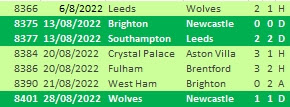
This season's results boosted that ROI to 28% with three winners from seven:
There were also a couple of matches this week that fell just outside the "Close" range but finished as Draws. These were West Ham v Tottenham (30.7%) and AFC Bournemouth v Wolves (31.7%) but since 2000, these haven't been a good investment overall, although in games where a Little 14 team is home to a Big 6 side the jury is out. 

August is historically the best month for 'hot favourites' in MLB, but not this year. Whether this is due to the rule changes previously mentioned here remains to be seen, but with a month to go, we're looking at a losing season with the ROI currently at -3.8%:
I did see this baseball betting 'tip' on Twitter:
This is very poor advice. 

With almost 19 seasons of data, blindly backing the Los Angeles Dodgers when favourite has a positive ROI from more than 2200 matches. 

If the 'tip' had specified 'Away / Road favourites' it would have had some merit (the Yankees are actually the worst team to back in this situation), but at home, these two clubs are actually the best of the 30 clubs to back when favourites.

Presumably the rationale for this suggestion was that being popular teams, the Yankees and Dodgers are typically over-bet, but the data doesn't support this. Validating your ideas is always a good idea. 

College (NCAA) Football is back as of last weekend, and with the NFL is just a week away with a Thursday Night game, it's a sure sign that Autumn is here. 

For the first time since June 2016, my overall year-on-year return is negative, and with September traditionally the worst month for stocks, things could yet get worse.

Tesla had a 3 for 1 stock split, but dropped more than 7% in the month, and overall my net worth dropped 5.6%, the 138th worst month in percentage terms of the 140 since I started tracking with, not surprisingly, August 2022 ranked dead last in real terms. 

The drawdown from April's high is 12.2%, not far short of the 14.1% I experienced during the March 2020 COVID-19 panic. 

The good news, I suppose, is that I am still employed. The bad news is that I might have to remain so for some time if I want to go out on a high, which would be psychologically optimal.

August was also a red month on the scales, but with my net daily calories averaging over 1900, this was no surprise and the damage wasn't terrible. Hard to lose weight when grandkids are eating ice cream and wanting to eat out most days! 

For anyone wondering about the post title, with the advent of September, adherents to the traditional advice recommending abstaining from oysters unless the month has an 'R' in its name will be aware that today is the first of 242 days in which the delicacy may be enjoyed. 

Sunday, 21 August 2022

Risk Is Personal

One of the accounts I follow on Twitter is Clifford Pickover and last week he Tweeted the following:

At the time of writing, it has garnered almost 1,500 replies, with a number of differing opinions, and one unfortunate individual saying:
I am color blind. Which is which?
There's always one, as my Mother used to say.

While it's unlikely any of us will ever find ourselves in the fortunate position of deciding which button to press, it's an interesting thought experiment.

Mathematically speaking, it's a no-brainer. The green button has an expected value of $25 million, the red of $1 million, and so you should press green every time, but we're human beings, not robots. 

Losses hurt and our personal circumstances tend to outweigh the mathematics when it comes to big financial decisions.

If you are a billionaire, you (presumably) press green, but if $1 million is a life-changing sum for you, it's not unreasonable to press the red button and take the guaranteed $1 million. 

The question gets interesting when it's applied to people with some money. What if you have $1 million already? It might hurt to miss out on doubling your money and you may well choose red, but what if you have $5 million? 

Risk is personal and our individual circumstances make a difference.

The 18th century mathematician Daniel Bernoulli came up with the idea of "utility" and understood that real-life decisions are dependent on an individual's circumstances. 

Someone posted a follow up poll, with the following results:
I wonder how close those numbers would be in a real-world scenario? 

Friday, 19 August 2022

Mind Your Meme Stock

A little over a year ago, on July 12th, 2021 to be precise, on the recommendation of a friend of my daughter, I invested a small amount in a small Canadian company called Mind Medicine ($MNMD).
It's not been one of my better bets, as the chart for the past year (above) clearly shows, but with a much larger investment in Tesla up 1,304% currently, it's money I can afford to lose. As Yahoo Finance stated:
Mind Medicine is a company very few people have heard of.
It was certainly a new name to me at the time, and its profile states, it is "a clinical stage biopharmaceutical company, develops novel products to treat brain health disorders related to psychiatry, addiction, pain, and neurology."

Something of a longshot in other words, and after months of steady declines in its stock price, all of a sudden I see that:
Its stock is up almost 50% today. Why? A college student made roughly $110 million trading Bed Bath Beyond, according to SEC filings. After a Financial Times report showed the student is also heavily invested in Mind Medicine, traders seem to have decided to pile in. Welcome to the meme stock club, Mind Medicine.
Things may be looking up. Definitions first, and:
A meme stock is a stock that gains popularity among retail investors through social media. The popularity of meme stocks is generally based on internet memes shared among traders, on platforms such as Reddit's r/wallstreetbets. Investors in such stocks are often young and inexperienced investors.
Many of you are probably familiar with the term 'meme', and while I've never jumped on a meme stock bandwagon, that I possibly find myself on one by default is somewhat interesting. I did jump on the Bitcoin bandwagon via a trust ($GBTC), but that has so far proven to be even more of a loser than $MNMD. A large element of FOMO drove that poor decision.

Some of the language on the r/wallstreetbets suggests a high degree of immaturity, but maybe that's just me becoming a grumpy old man. These bets are highly speculative and volatile and stocks often trade at prices that are above their estimated value based on fundamental analysis so be careful and don't get greedy if you are playing this game. 

Tuesday, 16 August 2022

Drowning in Draws, Visas and Trousers

It was a good weekend for Draws with the second round of EPL games this weekend producing no fewer than five. 

Two of them (Southampton v Leeds United and Brighton and Hove Albion v Newcastle United) were 'Close' qualifiers, with the next most probable Draws (Wolverhampton Wanderers v Fulham and Chelsea v Tottenham Hotspur) also finishing without a winner. 

Someone was happy:
The fifth Draw of the round, last night's Liverpool v Crystal Palace match, was an unlikely addition to the Draws column, although a very welcome one personally.

The high rate of Draws won't last though. The record percentage of Draws in top flight English football is 32.25% set in 1973-74 when the average number of goals per game was 2.4 whereas this season so far looks to be close to last season's 2.82 goals per game and goals are not good for Draws as most of you will know by now.

The extra Draws are coming at the expense of Away wins, which are currently at an EPL all-time low of 20%, but of course, it is very early days. Four of the Big 6 are away next weekend and all are odds-on.
During the weekend, @statsbet Tweeted the following:
@oddsvantage and myself were both curious as to what this might be a reference to, and it's our old friend Psychoff who is very generously offering one-to-one trading mentoring for the very reasonable price of just:
Which seems an absolute bargain for 30 hours of live trading with someone who is (modestly and self-described) as "one of the best football traders of all times (possibly the best one)".

Possibly, but probably not. If there was ever a huge edge trading liquid football markets, you can be sure that it's long been identified and blunted by the big players in these markets and if the edge is on Turkish Third Division matches, well the liquidity just ain't going to be there. 

Back in 2010 I wrote about Psychoff:
I wonder how long it will be before we see an invitation to share in the joy - for a small price of course.
While I was right about the invitation to share in the success, I have to admit that I was way off on the 'small price'.

Rumours on betting forums are that the money is needed for immigration purposes, i.e. generate an income, pay tax on it, and get a visa for the UK, but as one commenter wrote
Coupled with the fact, if it happens to be true, the reason behind the course is to pay tax to acquire a visa, you'd have to be completely bonkers to sign up.
Mind you, this was in 2020 when the cost was significantly cheaper and:
He's offering the basic and advice course for £2499!!!
The cost seems to have risen fairly rapidly from £1,000 to the current £39,999 but while there are many comments regarding the cost, there aren't quite so many saying what great value the course is. 
I've looked at the testimonials. There's no feedback from anyone who's done the £24K course.
With the median UK 2021 (April) gross salary at £31,772 I'm not sure demand for this training will be particularly strong, but I'm certainly beginning to think that offering the "Sacred Trading Manuscript" for a small fraction of this £39,999 was a big mistake. 

Future copies will be just £9,999 and you don't even have to watch hours and hours of live football every week. Just follow the rules, bet, forget, collect, and enjoy life.

And as a bonus, the results of all systems are easily verifiable, something which isn't the case for in-play trading 'systems':
It may surprise no one that there was no reply to this question. 

Finally, and following on from the Kiké Hernandez and The Case of the Extra Tight Pants story, Baz quite reasonably asks:
Will you try tight trousers to improve your betting? Publish the results please.
Unfortunately the answer to this question may well be known in just a few weeks given that August is not proving conducive to weight maintenance, never mind weight loss. It's a holiday month with children and granddaughters, ice creams, birthday cakes, meals out and other temptations that I can normally resist proving temporarily irresistible. 

Additionally, and while less of a factor than calories ingested, my exercise routine has also been significantly disrupted and my monthly goal of 100 miles on foot is in serious danger of being missed for the first time since November's feeble 93 miles.

I do have a week left in the month after my daughter and grandchildren leave, so if I am not too worn out, a few ten-mile days should get me over that line.

And then it's into the NFL season (pre-season has already started) with the NHL and NBA not far behind. Oh, and a World Cup. 

Thursday, 4 August 2022

A Longitudinal Study Comparing Performance and Pants Tightness

A few years ago, my wife and I were in attendance at a San Diego Padres v Los Angeles Dodgers game, when the Dodgers outfielder Kiké Hernández came to the plate.

Unprompted, at least as far as I know, (who knows what conversations had taken place as I was taking out a second mortgage to buy a couple of beers?), a lady in front of us turned around, looked at my wife, loud-whispered six words - "Kiké Hernández - tightest pants in baseball" - before turning back to the field and focusing very intently on the next at-bat.

It was an amusing moment, and with the two teams scheduled to meet again this weekend in Los Angeles, the topic came up in conversation this evening. While the "tightest pants in baseball" were easy enough to remember, at my advanced age it took a few minutes to recall the player's name, but I got there in the end.

Curious as to whether this was just one person's opinion or a commonly held one, and aware that I was risking some rather dubious advertising on my Internet browsing, at my wife's urging I typed the words "Kike Hernandez pants" into Google and was rewarded by the most entertaining Excel related post since Gareth Wild's Bromley car park thread on Twitter of a year ago.

The very first search result is a Reddit post from 2018 titled "Kiké Hernandez and The Case of the Extra Tight Pants". Unless the writer was the lady sat in front of us in San Diego, there appears to be a small cult built around Kiké’s pants, but more importantly this opens up a totally new angle for baseball analysis and research as we look for our edges! I must admit the tightness of a player's pants hasn't been an area I've thought about before, but this lady has gone above and beyond:

on april 23, i watched kiké hernandez go 3 for 4 with a home run, two singles, and two golden glove-caliber catches to help the dodgers win against the marlins at dodger stadium. his pants were particularly tight. i had noticed kiké had different pants in different games; all of them were tight, but some of them were extremely tight.

as the season wore on and kiké’s pants changed day by day, i began to wonder if kiké’s pants affected his performance in games. it seemed like the days when he wore his tightest pants were the days he performed the best, but i couldn’t tell if his performance was actually better on those days, or if i just paid more attention because i love looking at his hot butt. the more i thought about kiké’s pants, the more i convinced myself that this research was necessary and important. i worked on multiple research projects in graduate school, but i hadn't actually used my skills in the "real world" yet. this was my chance.

i began to chart kiké’s pants tightness game by game, matching it with statistics from baseball reference. i determined kiké has three tiers of pants tightness, which i named moderately tight, tight, and extra tight (hereafter referred to as moderates, tights, and extra tights). he actually has two subtypes of extra tights: straight leg extra tights and tapered leg extra tights, but for purposes of this study i grouped all extra tights into one category. please see this album for image examples of pants tightness.

then i had to figure out the best way to determine kiké’s performance in each pant tightness tier. i spent two months analyzing statistics, learning how to calculate them, and identifying the best options. i narrowed it down to WPA and OPS. after hours upon hours of calculations, questions to r/Dodgers, and lost sleep, i discovered an online OPS calculator that could have saved me a lot of trouble. i decided to calculate the OPS for each pants tightness tier; this was easily achievable using my detailed excel spreadsheet (found below) and the online OPS calculator.

i am proud to present my findings as part of my dissertation for the honorary Master's of Thirsty Baseball (MTB) from the University of r/Dodgers. i have summarized my findings in the paragraph below, and following my summary, i have attached my formal research paper and excel spreadsheet for your information and enjoyment.

my research has determined that kiké’s performance is significantly better when wearing his extra tights. kiké’s OPS while wearing moderately tight pants was 0.552; tight pants was 0.682; and extra tight pants was 0.974. he wore his moderates in 16 games, his tights in 37 games, and his extra tights in 35 games. the biggest different in stats was in home runs: kiké hit 10 home runs while in extra tights, while he only hit 4 in tights and 2 in extra tights. i have attached my excel spreadsheet here if you are interested in more in-depth statistics; if you filter the column by each pants tightness, the “subtotals” line at the bottom shows the totals per filter.

please see my formal research paper for further in-depth analysis of kiké’s pants and his performance. i think you will find it both informative and entertaining.

upon completing this research, it is my recommendation that kiké wear his extra tights as often as possible to improve his overall performance. we saw last night that kiké is an outstanding player (he was wearing his extra tights), and the data suggests he is not cooling off anytime soon. i believe increasing the frequency of extra tights will only serve to improve his statistics, and will definitely make me a happier woman.
about the author: u/ItalicSlope presents this research as her dissertation for her honorary master’s degree in thirsty baseball, to accompany her real master’s degree of social work. she is also a licensed notary. while she grew up in los angeles, she currently cheers on the dodgers from kentucky, where the trifecta of braves, cardinals, and cubs fans routinely harass her. she is passionate about baseball, concerts, NPR, tamales, hot baseball players, long drives, and lightning bugs.

The spreadsheet is a thing of beauty: 


And the abstract of the formal dissertation was great: 

This study focuses on identifying a correlation between the tightness of the Dodgers’ super utility Kiké Hernandez’s pants and his performance in individual baseball games during the 2018 season prior to the All Star break. The goal of this research is to address the growing interest of fans worldwide in determining the importance of pants tightness, and to provide justification for thirsty baseball fans in salivating over Kiké’s juicy butt. This study is both qualitative and quantitative in nature with a longitudinal design. Information was obtained through MLB.tv archived games (Major League Baseball, 2018) and game log data (Baseball Reference, 2018). The data was analyzed using the researcher’s custom developed analysis tool. This study will highlight information regarding baseball and pants tightness, barriers to the study, and study findings, as well as provide discussion around key findings.

Keywords: baseball, pants, tightness, thirsty, banana rally, juicy booty, hot guys
While one of the many comments was this one:
Currently watching the Dodgers v Giants game and the announcers mentioned there was a "15 page research paper" on the relation of the tightness of Kiké’s pants and his OPS, so naturally I had to find it and I was directed here. This is quality content.

Quality content  indeed.  

Tuesday, 2 August 2022

Soto and Euros (W)

In my half-time MLB report a few days ago, I mentioned that Juan Soto had:
"reportedly turned down a 15-year, $440 million contract extension last week, and will likely be traded."
While there were rumours at the time that my wife's San Diego Padres (she's a fan, not the owner) were interested, I didn't want to tempt fate by mentioning this, but apparently the rumours had more than an element of truth to them with Soto now headed to America's Finest City.

The Padres sit 12 wins behind the Los Angeles Dodgers in the National League West, but are currently in a play-off spot.

Pinnacle have cut the price on a Padres World Series win to 10.81 from 23.17 while the Dodgers are favourites at 4.6 to win with the New York Yankees second in the betting at 5.0.

The Women's Euros ended rather perfectly with a 1:1 draw at 90 minutes followed by an England win in extra-time. The seven elimination matches produced three Draws for a 3.81 unit profit and the other four games were all won by the favourite. 

While 65 matches is only a small sample, the total ROI on backing the Draw in elimination games (World Cup and Euros) is just 1% but in the 31 games with no odds-on favourite (at fair odds), the ROI is a rather more eye-catching 22%

Euros also seem to be more competitive than World Cups with an ROI of 21% compared to -14%, although if we exclude the Round of 16 matches, the World Cup returns become positive with an ROI of 10%.   

No winner for Draw backers in the FA Community Shield this season, but overall this is still a profitable event for this strategy. This is the first time since odds are available that consecutive underdogs have won:


Sunday, 24 July 2022

Humidor Dead Balls

With the break in baseball for the All-Star Game this week, I've been digging around in the MLB numbers this week trying to understand what might be causing the decline this season in home runs, hits and strikeouts and aside from the Designated Hitter (DH) rule that has been much discussed, there has also been a change to the type of ball being used. 


According to Sports Illustrated, there is a new "less lively ball" in use throughout the MLB, although interestingly the article mentions that it was introduced last year, but not everywhere. I would love to know where but I'm not sure these statistics are available and according to this CBS article, this mix wasn't intended. 

Not surprisingly, a "less lively" baseball isn't going to travel as far as the previously "more lively" baseball. What would have been a Home Run in 2021, at least in some games, becomes a deep fly-ball out in 2022. 

Apparently all 30 ballparks in MLB now use a humidor for storing the balls. I was aware that Coors Field used one, I believe as a condition for allowing the Colorado Rockies to become an expansion team (they play about a mile above sea-level where the air is obviously thinner), but I wasn't aware that they were now in use everywhere.

Last season 10 clubs had them, (5 NL, 5 AL), and as cigar aficionados will know, the purpose of a humidor is to dry out the ball in humid climates and dampen it in dry climates, and of course the drier the baseball, the further it flies.
By design, the baseball does not carry as far because of more uniform manufacturing specifications. (It was introduced last year, but this is the first season with 100% use of the less lively baseball.) Add the use of humidors in all 30 ballparks for more uniform storage protocols, and you get the end of a Rabbit Ball Era from 2016 to ‘21.
No wonder the Totals systems have become unusable. It was apparent that something had disrupted the markets, but until now I was thinking it was more likely the DH rule, but the change of ball is clearly a significant factor and I shall sleep well tonight. 

The CBS article concludes with this:
Bottom line, the baseball is not carrying the same way it did the past few years. The home run rate is down significantly early in the season, and because hitters have yet to adjust, offense is way down too. The season is still young and we need a lot more data before we have a full understanding of how this baseball works and the humidor's impact. The early returns suggest a return to 2013 and 2014, the last time teams averaged fewer than a home run per game, and offense was this low league-wide.

There's never a dull moment in sports betting with changes like this coming along - seemingly every season in the US sports.

The annual MLB system of backing favourites in their first game back had another profitable year, and all-time (well, since the data started in 2004) the ROI numbers for this simple system are now 13.2% (Money Line) and 12.5% (Run Line). Some of you might recall that I mentioned this back in 2016, if not prior:

One trend that did hold true again this season was that of favourites doing well in their first games after the break. The rationale for this is that although the better teams are likely to be better represented at the All-Star game, many of those will only put in a less than exhausting cameo performance, while the majority of their players enjoy the break and get some rest which apparently benefits better teams more than worse teams.

These once a year trends are of limited value of course - come next year and 99% of people reading this will have forgotten about it.

Hopefully some of you enjoyed a boost to your accounts this week but I suspect most fell into the 99% category.

The numbers for Away (or Road) favourites are even more impressive at 20.1% and 29.8% respectively. It's just a pity there's only the one All-Star game a year.

The Women's Euros Quarter-Finals wrapped up yesterday with two Draws from the four games, and a profit whether you backed the Draw in all matches or just the 'no-odds-on' game. It was very nearly three from four with Sweden unable to score against Belgium until stoppage time.

While we only have 12 Semi-Final games with prices from Women's Euros and World Cup, the four Draws mean that, as in the men's game, backing the Draw is a profitable strategy. 

Three matches had an odds-on favourite, with one Draw, and nine had no such favourite and three Draws. 

England are likely to be odds-on on Monday against Sweden, although they have drifted significantly, while the Germany v France game looks fairly even and would currently be a 'Toss-Up' if it were an EPL game. 'Toss-Ups' in men's elimination games have an ROI of 34%

Thursday, 21 July 2022

MLB Half-Term Report

As I've mentioned before, this MLB season saw a significant rule change with probably the biggest difference between the two leagues, i.e. the Designated Hitter (DH) rule, being implemented universally. 


For non-baseball fans, in the past National League (NL) pitchers bat whereas in the American League (AL) their place in the batting line-up is taken by a DH, and this rule now applies to both leagues.

As you would expect, more runs are scored in games played under American League rules (those where the Home team is an American league club) compared with games played under National league rules. Since 2004, and excluding the 2020 Covid season when the DH rule was also applied universally, the numbers are 8.4 in NL parks and 8.8 in AL parks. 

As you might also expect, edges that used to exist on betting Totals have been disrupted, and the Overall numbers are not good for this season:
However, the losses are all for NL games, with AL Totals still showing a profit, albeit of just 0.6% but all things considered, I think sitting out Totals for this season at least is probably the smart decision.

The disruption appears to have impacted the Hot Favourites System also, at least in the National League, but for American League clubs the system remains profitable with an ROI of 0.9%.  

After sizzling for several seasons the T-Bone System, which like many other strategies stopped working in the 2020 Covid season, appears to have been overdone and burned to a crisp as it continues to be a loss maker this season. I'll continue to spend time on this idea updating results, but not any money.   

I've mentioned in the past a couple of trends connected to the All-Star Break, with Favourites good value in their last matches before the break as well as in their first game after. 

Peter commented that:
Harking back to your 16/07/21 post about favs in final game b4 the ASB: 7-5 today not so flash but yesterday went 15-1 ! and Friday 9-5 perhaps the full 3 game series b4 the break is worth a look?

Always good to hear that someone is paying attention, and looking at the three days leading up to the break does show that the strategy is successful for all three days.

My post back then pointed out that:

Certainly blindly backing all favourites in the final game before the All-Star Break is a profitable strategy, +6.7% Money Line, +12.1% Run Line.

Here are the numbers including this year's data: 

Saturday this season was rather unusual with the largest return from all 42 days under examination, but a loss on the Run Line! 

As for backing the Favourites in their first outing AFTER the break, we wait. Here are the numbers up to, and including, last season from way back in 2004:

As for the game itself, the New York Yankees have the best record with a winning percentage of .688 (which most people would write as 68.8%) while the Washington Nationals have the worst record at 0.33. No wonder Juan Soto reportedly turned down a 15-year, $440 million contract extension last week, and will likely be traded. 

Women's Euros 2022

Quite a few comments in the past few days, and all are positive which is always a plus. Regarding the ongoing Women's Euros Tournament, I wrote on the 10th July that:

So far every odds-on favourite has won, while every game without an odds-on favourite has finished as a Draw.
It appears that quite a few of you were with me on this simple idea, and it certainly paid dividends. 

Of the 24 Group games, 19 had an odds-on favourite of which 16 won for an ROI of 7.9%, while the more open five matches produced four Draws for a meaningless ROI of 173% or 8.65 units.

Interestingly none of the seven longest priced favourites won, so a 'Lay The Favourite' strategy for any team priced at 1.6 or longer would have been worthwhile. 

The one result with a 'hot favourite' failing to win was the very last match of the round. Favourites France led from the 1st minute all the way up to the 12th minute of time added on when they conceded a penalty (converted) to Iceland for a 1:1 result. It was Iceland's third 1:1 score from the three group games, but despite being unbeaten in the tournament, Iceland were eliminated. 

Leading for 111 minutes and failing to win must be some kind of record!

Prices as short as those you see on the left above are not too exciting, but Larry wrote to say:
Lovely work on the Euro Women's. Round 2 been very profitable. Playing anything above 1.60 as a single and multi betting the real shorties.
Larry's selection of 1.6 as his cut-off appears to be quite prescient, but combining shorties into multiples is a good strategy I like to do myself when possible. 

None of you will remember my post from October 2010 when I mentioned my habit of buying the Racing Post back in the 1980s, possibly into the early 90s, but back then I wrote:
When the Racing Post started covering sports betting, I would buy it just for those two pages. I opened several telephone credit accounts with different firms, and would spend my daily train journey to London comparing the odds offered by them, noting down any prices that were out of line with the others, on sports such as football, the NFL, Formula 1, cricket, tennis, Boat Race, snooker, rugby league and union, and politics.
While I didn't mention it back then, I may have done somewhere else here, but one of my habits in those days was to lump short priced favourites together in multiples, exactly the strategy being followed by Larry. 

Despite passing my 'A' Level in Pure Maths With Statistics, it was often surprising to me just how rewarding a multiple of those shorties could be with, for example, a treble of three 1.3 shots paying out at 2.2.

Incidentally, that 2010 post mentions the exact moment when I realised that looking at the Draw in certain games might be a strategy worth following, and one category of 'certain games' is that of major tournament elimination matches, which is where we are now in the Women's Euros.

Previous Women's Tournaments haven't been a good environment for Draws overall, at least going back to the 2009 Euros, with an ROI of -2%, but in matches with no odds-on favourite, the ROI is a positive 11%. Quarter-Finals have a 26% ROI, Semi-Finals 9% and Finals 263% (with only one qualifier). The Round of 16 is a loss maker, but of course the Euros don't have a Round of 16 so 'Draw' you're own conclusions.

With no odds-on favourite in yesterday's England v Spain game and I took the Draw at 3.5 and a 1:1 result was an excellent start. The other three Quarter-Finals will all have an odds-on favourite, with Germany and Sweden very short. 

Finally. a few of you expressed interest in the 'Sacred Manuscript' mentioned in my last post, with Rob writing:
You’ve previously helped me with some queries regarding your systems which continue to make me a nice return. Thank you for that.

Always nice to hear. 

Next post should be a half-time look at the MLB season, as it takes a short break for its annual All-Star Game, won for the ninth consecutive time this year by the American League. At least one reader will be following the once-a-year system coming out of the break.

Saturday, 16 July 2022

Sacred Manuscript

"This is the nature of what we do. It's the intersection of business, people, psychology, sociology, and numbers. It's just inherently fascinating. There's a lot of macro factors and stuff that make sure you never have the game beat. Never."
The quote above comes from Michael Mauboussin who has spent more than three decades studying companies and the investment process.

Substitute "business" with "sports" and what most readers of this blog are trying to do is rather neatly summarised. 

As for the final seven words there, while it is true that no edge should last for ever, and we need to constantly evolve our ideas and systems as "macro factors and stuff" change, it is apparent that edges can last for a lot longer than we might expect. 

And yes, sports investing is inherently fascinating. Warren Buffett long ago moved past the point where more many had any utility for him, and is quoted as saying:
"In a sense, the game that I'm in gets more interesting all the time. It's a competitive game, it's a big game, and I enjoy the game a lot"
Compared to financial investing and Warren Buffett, for most of us sports investing isn't quite such a big game, but back in 2009 I described betting on sports as being a game:
I've never been one for games, (friends at work spend hours playing Call of Duty - why? What's the point?), but in many ways the exchanges are one big on-line game. It's me versus an unknown opponent. My opinion versus yours, except in this game the points are real money.

Thirteen years on and while a lot of things have changed, for example I no longer have any friends at work - the result of being moved to full-time work-from-home status rather than my personality, lest any of you be wondering - I do still enjoy the intellectual challenge of investing, and a little extra money is never a bad thing.

Sports markets are, or should be, examples of complex adaptive systems, but they are often verifiably inefficient. It's these inefficiencies we need to identify to gain an edge. 

A couple of comments on my recent Comment Review - Farewells, Draws and Muscle Mass post expressing interest in the document I mentioned "detailing the exact process and breaking down each step but it comes with details of 8 other long-term profitable systems".

The modestly named Onebrickshort wrote:

As a long term reader of the world's number one sports investment blog, I might also be interested in being able to purchase the sacred manuscript.

And Hkibuzz, a man of efficiency and few words, simply added:

Same here :)

I may steal the term 'Sacred Manuscript' for future use, as it appeals to my sense of humour, as does referring to this blog as 'the world's number one sports investment blog'! There's no downside to having fun while simultaneously taking sports, or any, investing seriously.

Unfortunately comments don't give me your email address, so if you are interested, please use the Contact Form on the top right of the blog or simply send me an email at calciocassini @ aol.com after removing the spaces of course.

The document is updated with last season's results and only the current MLB season is in progress. 

I may need to add another System since I mentioned here last weekend that:

To fill the off season for football, this year we have the Women's Euros, and so far every odds-on favourite has won, while every game without an odds-on favourite has finished as a Draw.

It's been a better suggestion than I imagined, with 12 of 13 odds-on teams winning so far (the only loss so far was Norway's at 1.91 yesterday), and of the other five matches, four have been Draws. The one 'Dog to win so far was Germany at 2.83 versus Spain, and both these teams are odds-on to win their games today.  

Sunday, 10 July 2022

Winning In Your Sleep, and Women's Euros

Some of you may enjoy this story about a guy who entered an online qualifying tournament for the World Series of Poker’s Main Event, fell asleep after working late, and won.

The online satellite cost $80, and Goldstein registered. But he was worn out from working late that day and went to sleep, forgetting that he signed up.

Unlike most satellites that are structured similar to a standard poker tournament, this one required players to go all-in every hand until there was a winner from the 126 entrants.

As a result, Goldstein’s cards remained live rather than being automatically mucked even though he was sound asleep and not clicking buttons at his computer. The whole satellite lasted a little more than three minutes, according to records from WSOP.com.

Goldstein, whose screen name is “GoldsteinE,” started out with pocket queens on the first hand and won nine consecutive all-ins to take the Main Event seat. On the final hand, he made a flush to beat his opponent, “Basil_Hayden,” who got $72 as a consolation prize.

Goldstein woke up early the next morning and said he had approximately 50 messages from friends informing him he won.

“I was just like, “There’s no way,’ ” Goldstein said. “And then I looked at my email, and there’s an email from WSOP.com saying come get your chips. Kind of a little surreal.

“I was literally getting ready for work, so I didn’t have too much time to comprehend it. It was more just, ‘Holy cow, I guess I’m playing the Main (Event) now.’”
The full story with additional details from the Las Vegas Review-Journal is here.

To fill the off season for football, this year we have the Women's Euros, and so far every odds-on favourite has won, while every game without an odds-on favourite has finished as a Draw.

France are odds-on to defeat Italy in the next match. Matches with no odds-on are usually good prospects for Draw hunters, but in the Women's game, this isn't yet the case.

The previous three Euros have just 21 matches (including group games) with no odds-on favourite, and only four of these have ended as Draws.

At some point, the Women's game should mature and become as competitive as the Men's, and perhaps this year is that moment. Something to watch, literally.

Sunday, 3 July 2022

Comment Review - Farewells, Draws and Muscle Mass

I was going to blame being away from my computer for a few weeks for getting behind with a few comments posted on the blog, but since they were all from May, I should probably just put my hands up and admit that sometimes I forget to go to the "Comments" page and allow publication of the non-spam ones, which are typically the minority. 


In reverse order, I had a couple from Mulldog regarding the departures from the betting scene of two long-time virtual acquaintances.
The partial end of an era with Mark calling it a day.
Mark Iverson finally called it a day for full-time trading as I wrote about here, and there's not much more to be said that hasn't been said already. The betting environment has evolved considerably in recent years,  and that Mark was able to stay ahead of the game for so long is creditable. 

I'm thinking that the slow evolution is what Mulldog means by "partial end of an era", but as I've written over the years, full-time betting was never a realistic proposition for me for a number of reasons, but that doesn't mean it's not worth pursuing as a serious hobby. Far from it in fact.

I was re-reading a book last week, triggered by a comment from SimonM back in April, and in it was this section:
Nature plays chess, not checkers. There are as many winning strategies in the game of life as there are species on the planet. The best play depends on local conditions and on the strategies of those around you. High-energy strategies have obvious advantages, but low-energy risk-averse strategies can be winners as well.
The book was the previously referenced "Burn" by Herman Pontzer, and is about how we burn calories, lose weight and stay healthy (more on this later), but the statement seems to me to apply quite neatly to the world of sports investing. 

We all have our 'local conditions' and ultimately, as I've stated before, we are all in competition with those around us, and if the efficacy of their strategies catch up with, or surpass ours, then we are in big trouble. 

A high-energy (high-risk) strategy of full-time betting comes at the cost of a career, pension contributions, paid holidays, sick days and the less tangible, but social, benefit of working with others.

The other departure Mulldog commented on was the sad loss of Graeme Dand, who had been a friend virtually for probably 15 years. 
RIP Graeme. I never realised Graeme was a reader here too.

Graeme loved his horse-racing, his spreadsheets and his family - though I'm pretty confident not in that order - and the high esteem in which he was held was obvious in the support and comments he received as he so courageously faced the end of his life. 

As for being a reader here, he was the first ever commenter back in 2008 and was heavily involved in the football betting / tipping competition I organised back in 2014-15. He was one of the "Bounty Boys" with a contribution to the pot and with his TFA Draws (D1-D6) entry, came out on top of the Draws entries. 

On May 17th, modern synthesist commented:

Only just discovered this blog, and it's really excellent. Is the EPL draw system explained anywhere? I'd be interested to know how it works.

"Only just discovered this blog"? Unbelievable! The world's number one sports investment blog (admittedly self-proclaimed, and somewhat tongue-in-cheek) and some people are still unaware of its existence! 

Better late than never I suppose, and as for the EPL Draw System details, basically the idea is to find games where the fair (after removing the overround) win probabilities for both teams are within 25% of each other. 

These are what I call "Close" matches, with "Toss-Ups" being a subset of these that are within 10% of each other. I use Pinnacle's Closing prices for calculating the 'official' results, but strategies can vary.  

I do have a document detailing the exact process and breaking down each step but it comes with details of 8 other long-term profitable systems and in fairness to those who have paid for this, it wouldn't be right to give away everything here. 

Finally, on the topic of burning calories touched upon earlier, there was this comment from unknown posted on my April month end summary post titled "Darwen, Tesla, Twitter and April Losses"::

Sounds like your muscle mass is decreasing if between 1500-1900 is your calorie balance. Increase muscle mass will raise your equilibrium. Then 1900 will be you base line and you'll require 2300 to increase fat deposits.

The part that triggered this comment was this:

The net calories trend I mentioned last month - 1500 or fewer net calories a day and my weight goes down; 1900 or greater, and it goes up - was unfortunately reinforced after a month of too much eating and drinking and not enough exercise meant that my daily net calories averaged 2181 with a consequent guaranteed weight gain.

Not surprisingly, the pattern has continued through May and June although I really need some months where my net is between that 1468 and 1912. It seems that I'm either all-in on losing weight, or I'm not. Here are the updated numbers through June:

My AUs column refers to daily pints rather than the UK's definition of two units to a pint, and yes, before anyone comments, the numbers are arguably a little high with those 'dry' months clearly related to weight loss. 

Summer months are in yellow and with only one (so far) seeing a decline in weight, albeit by just 2.2 lbs, this isn't a great time of year.

The suggestion to increase muscle mass seems entirely reasonable given that muscle burns more calories than fat, but easier to achieve in theory than practice I suspect. My preferred exercise these days is the aerobic walking and hiking and my 2022 target of 1,200 miles is looking far too soft with 900 miles already behind me this year. Maybe I should hit my target and spend the last quarter of the year in the gym building muscle!

Saturday, 2 July 2022

English Finals, Q2 22 and American League Hotties

Losses in the second quarter just ended set a new record, managing to beat the Covid panic losses of Q1 2020 by some margin, and this is also the first time that the first half of the year has been negative. 


Both the FTSE 100 and S&P 500 are down year-to-date, with the latter having it's worst start since 1970 when I was still singing treble and my income was half-a-crown pocket money a week, its purchasing power being slowly eroded by the 6.4% inflation rate at that time, a rate that is not too dissimilar to that of today.

Fortunately my income these days is slightly higher, and my voice slightly lower, so it's not all bad news. At some point in the future, hopefully soon, the markets will turn upwards again, and with the benefit of hindsight we will all look back and view the present time as a great buying opportunity. 

April actually started off rather well, with my all-time high set on the 20th of that month, but since then I'm down close to 9%

Sports investment profits have very little effect overall these days as I've mentioned before, but as this was primarily a betting blog, here are some numbers from June, although I was away for three-quarters of the month so the 'official' returns weren't close to my actual profits.

We had just the one football bet which was the National League Play-Off Final between Grimsby Town and Solihull Moors, with the Draw a winner at 3.58. Backing the Draw in English Finals in 2022 had an ROI of 86%, (impressive, but don't get too excited with such a small sample size), the full results for the season being:
A more meaningful ROI for this system is from the 138 finals since 2004 where the ROI is 8.5%.

Other than that it was just baseball, where the Hot Favourites made 5.15 units, an ROI of 2.7%, although again notably the National League selections generated a loss.
July, August and September (including a few October games) are usually good for this system, with that July 2016 loss something of an outlier.  

Friday, 1 July 2022

Doctor Doctor, Gives Me The News

It's always good to receive comments and feedback, and my old friend @DrTsouts was kind enough to send me his results after following some of my systems.


Overall his ROI is 7.1%, with the details (shown with the good Dr's permission) as follows:
The highest individual system ROI is from the low volume "English Finals Draws" followed by "Africa" (which was the 2021 Africa Cup of Nations played earlier this year) with the NFL systems also performing well.

With a losing ROI of 35%, the MLB Overs system is the biggest drain on the profits, but as I mentioned in the last post, right now I am not involving myself with games with National League clubs due to the changes to the Designated Hitter rule. As we saw this season with the NBA Overs System, when there is a significant rule change, established edges can rapidly be eroded, although in the case of the NBA the outcome was fewer bets rather than a lost edge. 

The reported EPL Draws loss was interesting given that for the Close matches my ROI% numbers for last season are 2.4% and for the Toss Up matches, 14.6% but Dr Tsouts confirmed that these results were for the second half of last season and as I wrote in January, this system declines sharply after December, a trend that continued in the season just ended, with the numbers for the two 'halves' since 2000-01 updated below:
Before you ask "well why don't we just follow this system for the first half of the year?", there are some interesting trends when looking at the day of the week when the matches are played. For example, one big exception is qualifying matches played on an April Saturday, which were again profitable this season. Wednesdays are also solid throughout the season: 
Anyway, many thanks to Dr Tsouts for sharing his actuals, and allowing me to share them with you all.