Friday, 3 February 2017

Trading Life of Brian

Betting Tools' Brian has written a post titled "Tennis Trading With Courtsiders Present" which is, rather unusually for a betting blog, very well written and worth a read.

Unlike most sports betting / trading bloggers, Brian lays his thoughts out clearly, and appears to have studied English past the age of 14. 

I'll let you read the post yourselves, but I wanted to discuss a couple of Brian's paragraphs. He writes: 

Well aside from the endless hours of watching tennis and being extremely patient you have to enter the market between service games or at the end of sets. You know that the sit-down period every 2 games is 90 seconds and with the overround tight at little over 100% you can’t get stung. If there are no gaps in the prices and plenty of liquidity either side you can be confident that the odds are statistically accurate otherwise one side would be picked off by someone with a more accurate model. It’s the job of liquidity providers to set the odds as accurately as possible and pick anything off either side of it.
Brian is correct that when the Back and Lay prices are separated by 0.01 point, you won't get too badly hurt, but the problem is that while your edge is only minimally negative, it is still negative, and when you factor in commission, it is significantly negative. 5% is a lot!

If the prices are 1.5 to back, 1.51 to lay, the 'true' price is somewhere around 1.505, i.e. less than 1.51 and greater than 1.5. Now unless your model is better than those in use by the court-sider syndicates, backing at 1.5 or laying at 1.51 is a long-term losing strategy. 
  
Later, Brian writes:
Does all this mean that you can’t consistently profit? No, but it makes it very difficult. As my dad used to tell me, “no matter how good you are there’ll always be someone bigger, better and stronger out there than you.” This difficulty exists in all forms of sports betting and trading though and tennis is no more difficult than any other in my opinion.
Describing the probability of overcoming court-sider syndicates as "very difficult" is one way of putting it - a little like telling your wife you're stopping for a quick half after work before arriving home by taxi at 3am - but Brian's Dad's words are always relevant when making a decision.

Think of the Apple guy and his misplaced conviction that the stock price HAD to fall. What is it about an individual that makes them think they have seen something that others, in this case full-time analysts whose job it is to analyse Apple's numbers and statements, have missed? 

Later, Brian writes:
With a lot of hard work though, it is possible to profit regularly from manual trading and I’ve seen enough evidence from my own trading and that of others to be confident about this.
This is certainly true, but no longer in sports such as tennis.  
I also think that there may be some sceptics trying too hard to prove what they believe i.e. that it isn’t possible and that there’s very much an element of curiosity with some.
Perhaps pointing out that it is illogical, and rather unlikely, to believe that you are better than all the court-siders who trade tennis for a living and are in direct competition with you, is being sceptical, but I'm certainly curious as to how anyone might seriously think that.   
As intelligent as you may be you just might not be suited to sitting watching, reading and evaluating a tennis match in play and controlling your emotions, particularly if you don’t enjoy the sport. If you do and can make it work however, it is only you who knows whether it’s worth the consistent effort.
Tennis for me is a game to be played, not watched, and the length of tennis matches is another reason why I have never got into the sport as a trader. I'm realistic to know that I will never 'evaluate' a tennis match as well as others who love the game and do this stuff every day. 

And if anyone comes along who can beat the court-sider advantage, rest assured it'll be very short-term as the court-sider models will adapt.

Brian ends with:
So, is consistently profiting from manual Tennis Trading where courtsiders exist impossible? No, but courtsiders or not, it is very difficult and for a very high percentage it’s unlikely.
On that, we can agree.  

Thursday, 2 February 2017

One Shilling: The Difference Between Happiness and Misery

Following on from yesterday's Lottery Losers post, and a timely tale today of someone who apparently has trouble managing their money
Johnny Depp's former business managers counter-sued the actor on Tuesday claiming his lavish lifestyle that cost more than $2 million a month to maintain caused his recent financial troubles and that the star ignored their repeated warnings.
The counter-suit filed in Los Angeles Superior Court by The Management Group comes about two weeks after Depp sued the company alleging it grossly mismanaged his earnings.
The lawsuit said Depp paid more than $75 million to buy and maintain 14 homes, including a French chateau and a chain of islands in the Bahamas.
Depp also spent heavily to buy a 150-foot yacht, fly on private jets and cultivate collections of fine art and Hollywood memorabilia requiring 12 storage facilities to maintain, the lawsuit said.
Depp was repeatedly warned by the company that his spending was out of control but ignored his former advisors' advice to control his spending, the lawsuit said.
"Depp, and Depp alone, is fully responsible for any financial turmoil he finds himself in today," the lawsuit stated.
Depp sued The Management Group on Jan. 13 seeking more than $25 million he contends was mismanaged. His lawsuit also alleged the company failed to file Depp's taxes on time, costing him $5.7 million in penalties.
Possibly the most distressing part of this story was the writer using the same word at the beginning of four consecutive paragraphs!   

More seriously though, as Wilkins Micawber put it: 
"Annual income twenty pounds, annual expenditure nineteen pounds nineteen shillings and six pence, result happiness. Annual income twenty pounds, annual expenditure twenty pounds ought and six, result misery."
Sadly, I am old enough to remember shillings and (old) pennies. 

The Crazy AAPL guy had a torrid day with AAPL closing at a crisp: 
So much for 120 or less, and perhaps the story was genuine. Only the poster knows for sure, but here's one commenter's take on it:
I was there during the live stream. The emotions fscomeau showed, seemed to be pretty legitimate. The pre-earnings anxiety, and nervous-like talking, to distract his mind. The second-by-second gesture, and watching him input numbers into Excel, showing what his gain or (loss) was - and the emotions that rocked him, were all too real - and reminiscent of my own past experiences.
I will give him the benefit of the doubt, given his explanation as to using the demo account. (Which he explained was used to cover up his account name, etc. He also posted an actual picture of his losses earlier on reddit. Yes, I know it can be photo-shopped - but given what I just spoke about (emotion) I'm giving the benefit of doubt).
It was painful to watch. At 125.00 his loss was $150,000, so at 128.75 he's pretty much lost the lot, down around $270,000.

My days of trading options and futures are long behind me now, and my holdings of individual shares are limited to a handful, well six to be precise - it's a side-effect of living downwind of Windscale

Index funds might be boring, but they're hard to beat long-term. As Scott Adams said on the top of high-cost active v low-cost passive investing:
I can think of many cases in which I would recommend active money managers over index funds. For example, I might be giving the advice to someone I hate or—and this happens a lot—someone I expect to hate later. I would also recommend active money managers if I were accepting bribes to do so, if I were an active money manager myself, or if it were April Fools' Day. And let's also consider the possibility that I might be drunk, stupid or forced to say things at gunpoint. I've also heard good things about a German emotion called schadenfreude, so that could be a factor too. 

Wednesday, 1 February 2017

Lottery Losers

If Apple's stock price goes up, well...
Well.... up went the stock price. After hours trading saw the price close at $125.10 so our friend is in a heap of hurt, or would be if the thread was genuine, but it appears this is not the case as the DU prefix on the poster's account number apparently indicates it's a "Demo" account.

It made for a good story though, and it was believable because so many people are clueless when it comes to money. Who isn't familiar with the lottery winners who, within a few years of their win, have run out of money. This shouldn't be a huge surprise since it's the mathematically illiterate who enter lotteries week after week, so when one of them wins big, they're at a loss for how to handle it. 
   
James commented:
Without attempting to start an argument, this reminds me of the socialist ideal of spreading wealth. Some would like to evenly distribute all money to everyone in the world but this story shows that such an ideal would be folly.
It is estimated that there is $70 trillion in cash and so our approximate population of 7 billion would each receive $10,000 each. Within weeks there would be millionaires and billionaires again but many more poor people. All because people would start racing to accumulate more cash or more trappings of wealth.
There would probably be different faces amongst the billionaires. Maybe previous billionaires would be penniless because this time the gamble didn't pay off. Millions would be whining again because others have more than they have.

We would soon be as we are today with those who accumulate cash, those who are unable to save any cash and those for whom money slips through their fingers because they believe they deserve a certain lifestyle.
When has James ever NOT attempted to start an argument? I remember first hearing the above argument in school and while luck plays a huge part in our lives, the basic truth is that we are not all born equal. 

Fortunately most readers, although definitely not all, are able to hold down a job if they want one, and if accumulating money is your goal in life, then a few simple rules mean that most people can retire comfortably. 

Bossman Megarain, who originally posted the link to the story wrote:
It's v possible its a massive hoax, but, was a decent read, and passed the day.
As a set-up, the mkt being weak today, will maybe exacerbate any weakness in the Apple earnings, so, have a token position .. short.

I seem to recall u are flying for the Superbowl .. via a John Grisham interview/podcast, on Brian Koppelmans- State of the moment, I listened to a book, called 'Playing for Pizza', which has a NFL Qtr-back, as the hero. Its a v good read, and something u can happily pass the flying time with .. if u havent read it.
I hope the token position hasn't hurt the bottom line too much. As Mark Iverson can tell you, it's never a good idea to go in too big at the end of the month. Hmmm.

Thanks for the flying time recommendation. I am set for this trip, but I shall be back in Philadelphia yet again next month, this time with the lucky, and lovely, Signora Cassini, to celebrate the anniversary of my birthday and possibly meet some of her American relatives. 

Just to be clear, I'm not actually attending the Superbowl in person. I'll be watching the game in a Philadelphia bar with my son and a few of his friends. 

It promises to be a good weekend for sports, with England's opening Six Nations games on the Saturday conveniently kicking off shortly after a rejuvenated Crystal Palace pick up another three points, versus Sunderland. Some say this has been a poor season for Palace so far, but being just two points behind the champions in February surely can't be that bad? 

You did read it here first (August 2016) that Leicester City were a lay all the way this season.
Back to football, and while I'm not a big fan of tying my money up for a full season, I have had a few bets matched laying Leicester City in the Premier League this season, including for a top 10 finish at 1.46. I suspect that Leicester City's bubble has burst, and with the added distraction of Champions League football and a key player departing, can see them struggling rather like Ipswich Town did in their first season (17th of 22 teams) after surprisingly winning the League.
Never mind doing an Ipswich Town - they could match Manchester City's 1937-38 record of following a championship win with relegation. Even more bizarre was that Manchester City were relegated that season despite being top scorers.  

Tuesday, 31 January 2017

AAPL

Courtesy of Megarain's latest post, I came across a story which may or may not be true, (there are a few inconsistencies in his tale) of someone who unexpectedly inherited Can$2.5million three and a half years ago, and now has:
$325,000 Canadian left. I have a $100,000 personal loan at 8% (yeah), a $51,000 credit card debt accruing at 19% per year and various debts ranging from 6 to 10%. Oh man I feel so dumb – I could have paid the car I am driving in cash, but somehow I ended up getting financing
In an attempt to win back some, all or more of his 'lost' money, he's shorting Apple, whose earnings come out today (Tuesday).

He's certainly convinced himself that Apple will disappoint the market, and needs the current price of $121.63 to dip below $120 to start making some money.
If Apple's stock price goes up, well...

Also concerning was the line:
Look, I’ll be blunt: I want my two point five million back. It’s mine and I want it back, period
Something tells me the poster hasn't yet accepted his losses. "It's mine"? No. It WAS yours, but not any more.

I concur with Megarain's anonymous commenter, who wrote: 
Interesting read. I have to say that the guy sounds like a bit of an idiot though.
' but if you do exist God: please, please, please, please, please help me. I have never been lucky in this life and you have thrown many obstacles in my way, but if you help me here, everything is forgiven.' --> writes the guy who inherited 2.5 mill from a random uncle.
I think even if the trade goes his way, he'll find a way to squander his winnings.
It's a very generous offer to god that he will forgive him, and of course god has nothing better to do today than fudge Apple's numbers to help this guy.

Apple's earnings are always of passing interest, but I'll be thinking of this story when I see the numbers today. On a day (Monday) when the NASDAQ dropped 0.83%, (thank you Mr Trump), that AAPL closed the day little changed from Friday may not be a good sign for our Canadian poster. We shall see.

One interesting piece of his post was his start in trading soon after inheriting his millions:
I wanted to trade. I had always wanted to trade and the world of day-trading seemed like a utopia to me. At first, I had success.
People might remember my big Apple bet a few years ago where I essentially made $30,000 in under a week.
Looking back at it today, much later, I regret winning that trade.
Perhaps if I had lost everything on that trade, it would have disgusted me from trading forever and I would still have much of that $2.5M today.
But I won, and I won for a good while, and it kept me going.
Then, I began to lose.
I've heard others say that the worst thing that happened to them was winning that first bet / trade. Be careful what you wish for.  

Monday, 30 January 2017

Utopia

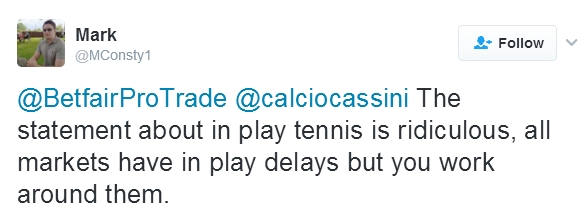
Racing Victoria's Mark Constable appeared to be confused about 'delays' when trading tennis in-play writing:

I'm not sure what "the" statement refers to, both James and myself have made several statement, but yes we can agree that all in-play markets have a delay for entering new bets, typically five seconds but not always, but that fact is completely irrelevant to the topic that was being discussed, i.e. tennis trading and court-siders.  

It later transpired that what was "ridiculous" about this was that Mark doesn't actually know anything about tennis trading, as he tweeted in a reply to Betfair Pro Trader James :
I'm glad that's cleared up then. For a while there I was thinking that Mark had found a way to beat the court-sider advantage in tennis, which would have made for an interesting read. 

What did make for an interesting read was Betfair Pro Trader's latest post "It Doesn't Get Any Easier". Yours truly gets a mention or two...
As Cassini points out, trading tennis in-play is only for syndicates with court-siders plugged into algo-bots. Sitting at home with a delayed video feed will do little more than earn trading profits for the syndicates and subscription profits for the vendors.
... but there's a lot more to James' post including his thoughts on the financial markets and a utopian future:
The AI of the future, which creates efficient markets that are difficult to lose money in will probably be powerful enough to ensure that nobody needs for anything and there will be better things to do than risking money for gain. Maybe money itself will become obsolete. Until then, you have to hope that you are on the side of the informed and not the uninformed (or misinformed).

Of course, some sports exist solely as a conduit for gambling. Horse racing being the most prominent. There is nothing I can say that would console those who would mourn the loss of horse racing, but if given the choice I'd rather live in a world without want of food and shelter than one with a want for horse racing.
Deep stuff, and I fully concur with James' thoughts on horse racing. I used to enjoy the occasional day out at the races, and my daughter still loves her Royal Ascot, but for both of is, it's the social (ok, drinking) side of the day that appeals. That horses are running around is merely the excuse.

Tony Stephens, possibly his real name, finally found time to comment on my response to his question, writing:
Thank you for the detailed responses. I have been too busy to respond until now.
As you can imagine, there has been a massive uptake of my latest book as a result of some recent publicity. The warehouse has been shipping them out 24/7. At times I’ve been on the shop floor myself and giving the lads a hand. This has unfortunately taken me out of the trading arena so you may have found the markets to be a little thinner than usual.
Skimming through the musings I eventually found what I believe to be your answer: “..writing is fun . I enjoy it; it’s relaxing …and interesting.” So you could nearly fill a full line with this information.
What I did also find was quite a lot of supporting evidence that the older generation now have the basic concept of how to use a search engine. I must write to Which? Computing to congratulate them on the success of their campaign to raise computing standards for the silver surfers.
On a slightly more serious note, I would be wary of anyone that gives out information on sports trading unless you have absolute confidence about their motives, character and their real name.
That includes even me!
Yours in trading, Tony Stephens
That was actually quite a good response from Tony, and I feel rather mean now about my digs at West Ham. It's not as if I'm in a good place to tease others about their football team right now. When the book is ready, please ship me an advance (complimentary) copy from the back of the warehouse and I shall give it an honest and impartial review.

Finally, when I see Tweets on my timeline from the respected Joseph Buchdahl, there's usually an interesting article or topic to look at. 

After reading James' article John, possibly his real name, said:
interesting , although each " sport " a small % of elite will always ' win ' .So why not trading?
Joseph's response was spot on as usual:
Some readers may recall the name Daniel Kahneman from this blog, but I appear not to have mentioned his 2011 International Bestseller "Thinking, Fast and Slow" which sits on my bookshelf at home and which I can highly recommend.  

It's a fascinating read, with the Financial Times reviewer describing it as: "One of the greatest and most engaging collections of insights into the human mind I have read". 

Steven D Levitt of "Freakonomics" fame described the book as "a lifetime's worth of wisdom". 

I'm not sure if the Nobel Prize winner came up with the term "zero validity environment" perhaps f.k.a. a random walk, but it as where I first saw the term and as Joseph says, trading does fit the (near) zero validity environment. 

Paraphrasing Jason Kelly, author of "The 3% Signal":
What we learn from past experience can help us in future experiences. This is not so in the sports betting markets, where fluctuations follow no patterns precisely, despite what you might have heard.
The lessons you learned in the last event won’t necessarily help you in the next one. Experience in the sports betting markets doesn’t accumulate to create disciplinary wisdom the way it does in other walks of life. In fact, the very lessons we learn from past markets can lead us astray in future markets.
Anyone read The 3% Signal? Reviews as to its efficacy appear to be mixed.  

Saturday, 28 January 2017

The Pimp Syndicate

It used to be a rarity that the daily hit count would exceed a thousand, but the past week has seen a huge uptick. Unfortunately the daily posts will be interrupted as I take another trip to Philadelphia, this time for a mid-Winter break which happens to coincide with the Superbowl.

James took a break from his new book "Reverse Portuguese Calculus" to ask about his latest best seller:
Am I writing this blog in my sleep or something?
Is the book any good, that's what Tony (and others) want to know.
I haven't finished it yet, but with a few hours of flying time coming up, I hope to have it completed by the time I return, but so far it hasn't disappointed. As you might expect if you read James's blog, it's targeted at the more discerning reader, and tells the truth as unpalatable as that might be to some people. 

James also replied to Prabhat's question from a couple of days ago, which I shall repeat here for clarity. Prabs wrote:
So are you saying that other than the information edge from knowing the game state earlier, there is no edge at all in sports betting?
Apologies if I'm getting you wrong, but from what you said that necessarily follows, since all the data is visible in pretty much every major sport.
Not agreeing or disagreeing for the moment, just trying to establish whether that's what you think.
I posted some thoughts of my own here, but James had a fuller reply, and is far more knowledgeable about tennis trading than I am:
As Cassini said more recently, it depends on the sport and the level of competition. You would think that Slams and high ranking point ATP/WTA tournaments are very closely watched by those in the know.
As I say, in another publication (available from independently reviewed booksellers), there are those who specialise at trading the lower level tennis tournaments and soccer leagues.
However, they must also factor in match fixing, which can eat into any informational edge they may have.
You could trade players outside of the top 100 in Challenger and Futures tennis tournaments but it only takes one or two bad eggs to throw matches and put a spanner in the works.
Personally, I am not a fundamental trader, just a technical trader. I have considered setting up a syndicate but it would need muscle as much as brains to run it. I know, from other income streams, that when you start to drain someone else's income stream they tend to plug the hole by putting a hole in you.
I was approached by someone wanting to set up a tennis trading syndicate. I did some research on him and discovered he was a convicted pimp. That's the sort of people you are dealing with.
No thank you.
The problem with setting up a tennis trading syndicate at this stage of the game, i.e. several years after the first syndicates started up, is that your competition is already in place with plenty of experience. In 2015, a BBC article reported:
Steve High says he has been told reliably that 75 people were at last year's Wimbledon final, "sending information back or betting on their own".
At some point, there's not enough money to go round. James mentions the more serious issue of match fixing, and the same BBC article has this to say:
Even supporters of tougher measures against courtsiders, like Chris Eaton director of sports integrity at the International Centre for Sports Security, thought the police had picked the wrong target.
"Courtsiding should be criminalised but the fact is it's a very minor issue compared to match-fixing and the corrupting of sports organisations in South-East Asia," he says.
European football is also mentioned in that BBC report, and if cricket is your sport of choice, in 2014 the Daily Telegraph reported:
The England and Wales Cricket Board released the fact that in summer 2013 there were 23 people ejected for what was believed to be courtsiding. 

Friday, 27 January 2017

Road to the Warehouse - Poor House

Here's Tony A celebrating a West Ham United throw-in

It's an unusual career path to go from being a risk specialist with an investment bank to working in a warehouse, but life is full of surprises. 

Our contributor Tony, "The Only Way Is Essex", Stephens has trodden such a path, at least if one of his Twitter profiles is to be believed, and with a grand total of four (4) followers, perhaps it isn't. 

A second Tony Twitter account, this one not protected, is faring much better, almost twice as well in fact, with a total of seven (7) followers.

Here's the profile picture for that account:
Here's Tony B celebrating West Ham United winning a corner
Notice the similarity? 

It was also amusing to read that Tony's Skype Id was at one time "getintheir". Get in their what? Their face? Their way? Their washing? 

We'll never know. Probably he meant "getinthere" which would make more sense. Perhaps poor grammar is why the investment banking career didn't work out?

The quality of Tony's ideas about trading can be seen in this example:
Market prediction - if you think about maximising profits and minimising losses it almost doesn't matter if you guess up or down in terms of price prediction. However if you have some reasoning i.e. the fav has drifted then maybe the another horse is shortening then this might help predicting the movement correctly.
As little as I know about horses, I'm pretty sure that if the favourite has drifted, somewhere in the market, at least one other horse is shortening. 

"Maybe" ? Well these pesky betting exchanges can be tricky to understand, but as the proud owner of Caan Berry's horsey trading guide, you'd think such a basic market dynamic would have been covered.

As for admitting that you guess where prices might go, well good luck with that.

If you are serious about trading, I can strongly recommend Betfair Trading Techniques by Mr. James Butler.     

Thursday, 26 January 2017

The Emperor And The Worm

A Tony Stephens commented. Now Tony Stephens is certainly not the rarest of names, but I do hope it's not the same Tony Stephens as the one above. 

"Just pick the winner whatever the price" is about as clueless a statement as you could find about betting, and as for not understanding the concept of betting exchanges, dear me. The basic idea is really quite simple, and it's being profitable that's more of a challenge. I'd suggest that anyone having trouble with understanding betting exchanges should probably stop right there.

And let's hope he's not the Tony Stephens below either:
Anyone working in a warehouse probably shouldn't be spending either his spare time or little money - that extra penny makes all the difference though...
...on gambling. 

Anyway, I'm sure it's another Tony Stephens who asked:
Could you explain why you like to blog about sports trading? If you know something that others don't why go through the "agro" of trying to prove it. If you manage to convince people you give away your edge or take mug money out of the market that you could exploit. If you don't convince people then you have wasted your time. Maybe hit counts help the ego more than realised profits?
A few points to address there, starting at the top - why do I like to blog about sports trading? 

For a start, writing is fun. I enjoy it; it's relaxing and writing about sports trading is particularly interesting in that there are so many topics, as evidenced by 2,238 posts in almost nine years, to write about. 

This blog is not solely about sports trading of course, as the heading makes clear:
...and related items of interest in the wide world of sports investing
That's a big world, and I write on other topics too as the mood takes me.

I'm not sure what Tony's next line is getting at:
If you know something that others don't why go through the "agro" of trying to prove it.
If the topic here is the recent one of how trading tennis from your home isn't a good idea, I'm presenting a logical explanation for why it's not a good idea. 

I'm trying to warn the vulnerable "warehouse workers" of this world, who might read somewhere that there is a fortune to be made, that in reality, trading tennis might not be the best idea for them. 

It's extraordinary claims that require extraordinary evidence, and the irresponsible claims of certain vendor bloggers that the novice tennis trader can simply jump into the Australian Open and make money is an extraordinary claim. 

I have yet to see any evidence to back that up, let alone extraordinary evidence. I'm simply saying the emperor has no clothes, and it's no "agro" to do so. 

I'm not a tennis trader, so pointing out what should be obvious doesn't hurt me at all. The interest that has been generated lately suggests my time hasn't been wasted. 
Seeing the hit counter climb is somewhat rewarding, but it means nothing in monetary terms. Writing for its own sake is a pleasure; that others read what I write is gratifying, but blogging is just a hobby.

Prabhat returned, asking:
So are you saying that other than the information edge from knowing the game state earlier, there is no edge at all in sports betting?
Apologies if I'm getting you wrong, but from what you said that necessarily follows, since all the data is visible in pretty much every major sport. Not agreeing or disagreeing for the moment, just trying to establish whether that's what you think.
Prabhat's question is probably for James, so next time he stops by, he can perhaps reply.

For my part, I'd say that sports trading and sports betting (bet and forget), are two different beasts, and if you trade in a market where court-siders are present, you are unlikely to be able to find an edge, because as stated previously, your ability to do this depends on the early-bird not seeing the worm. 

When it comes to sports "betting", I'd say choose your markets carefully.

James is right when he says:
You can analyse an up-coming match and place a bet on it but all the data is public so there is probably not going to be any edge.
However, not all markets are subjected to the same level of scrutiny, at least not yet.  

Wednesday, 25 January 2017

Elucidation

Despite my best efforts to bring clarity and logic to the issue of court-siders, some people continue to not quite grasp the logic, or perhaps not want to grasp the logic, with Prabhat writing:

I'm a little unclear what the claim is with regarding to court-siding and the lack of an edge.
Betting on tennis, your edge can presumably come from the following factors:

a) Better understanding of the relative strength of the players. (This is where you admit there can be an edge).
b) Better understanding of (a) with respect to given situations. I.E. How likely is Wawrinka (or a generic player) to make a comeback two sets down vs Federer (or a generic player). I'm not sure whether or not you think there can be an edge here.
c) Better knowledge of what is actually going on. (This is court-siding). AKA average mug thinks score is 30-40 or 40-30, courtsider knows it's 30-40 and is betting accordingly.
I am extremely unclear on why
a) The courtsiders edge persists during a changeover when everyone knows the score.

and

b) Why you are absolutely positive that a court-siders temporary information advantage is so strong to nullify all analytical edge anyone might have.

I am not saying it can't be. I'm just saying I don't see where you have made this case clearly.
Your analogy is betting on the colour of the next car against a guy 100 yards ahead of you on the road. My question is if you'r betting on "more black cars than blue in the next 1000" why would a guy ahead on the road have such a huge edge compared to someone who's studied traffic distribution patterns?
Fortunately James is here with an extremely clear and concise response (much more of this, and I'll need to add James to the payroll):
You might be confusing betting and trading. I apologise, if you are not.
You can analyse an up-coming match and place a bet on it but all the data is public so there is probably not going to be any edge.
When trading in-play new information is being created all the time and you need to be the first to get that information to trade it with an edge.
Yes, at the changeover, the playing-field is level but then you are back to the betting problem and all information being public.

There will be the ill-informed who are wading into the market with daft ideas and you need to be fast to grab their volume before the professional set-ups.

I shall discuss some of this in my next article.
We look forward to that next article. I'd add that when I read Prabhat's comment, it seemed like he felt the court-siding syndicates bet ONLY based on what they were seeing, but this is not the case. I may have been influenced by Prabhat's views in June 2014, when he wrote:
As far as better analysis is concerned, what I mean is that some people will be better at analyzing data at the end-of the day than others. True, some financial data will reach big players before others and thus be 'old', but unless those big players are analyzing it perfectly, the fact that they get data in advance isn't going to result in the market automatically 'digesting it'.
That's a very optimistic, but unrealistic, viewpoint. The court-siding syndicates will have "studied traffic distribution patterns" at least as thoroughly as you have, probably more so, and since they are likely to have more resources than the individual, you're not going to have an edge here either. Do you really believe you know the probabilities for a Wawrinka comeback v Federer from two sets down better than everyone else?  

The idea that these groups are paying good money to gain an advantage that they then waste by not knowing what to do with it, just doesn't stand up to close scrutiny. This idea is as illogical today as it was back in mid-2014. 

Hopefully Prabhat, and everyone else, is clear now. This topic has certainly been good for the hit count.
 

Tuesday, 24 January 2017

Click Bait

The hits keep coming. G, possibly not his full name, wrote:
Have to say the recent blog posts regarding the world class sports traders (Sir's Webb & Berry) have made for cracking reading but I do worry that you may be "due a visit" soon.
I do wonder why you have them on your blog roll though & I find the temptation to click on their links often too hard to resist.
Only yesterday I was seduced (nay-hypnotised) by Sir Caan's WOM headline and the next thing I know WOM makes perfect sense, my ebook was delivered in the blink of an eye and I'm awake at 2:00AM trading the AUS open- it's so easy. All this court-siding nonsense of which you speak I never even noticed. Unfortunately I don't think I'm allowed to forward on the ebook to you but not to worry I plan on delivering an online tennis trading masterclass before Wimbledon starts- it'll be called Sultan2  Anyway keep up the great blog- it's better than ever and I've been following for a good few years.
The standard of witty comments, albeit with their serious points, appears to be reaching new highs these days. Incidentally, a more professionally written post on WOM is here

G raises a good point about my having the blogs of Messrs Caan and Webb included on my blogroll, and while it's something I've thought about doing previously but gone no further, it's probably hypocritical of me to keep them there. 

Their presence implies approval, not to mention that both blogs are unusual in that neither one reciprocates and links to other blogs as is typical. One can only wonder why that might be. Surely the opinions of others are not something that world class traders should be concerned about?

Anyway, a great comment, and the kind words are appreciated. "Better than ever!" Did you see that James? 

James probably has, and here is a comment he posted which I had missed, replying to Tennis Trader's statement:
so in your belief all inplay sports betting is dead then
in a far more eloquent way than I could muster, as might be expected from a best-selling author. James writes:
A sensible trader is a logical trader.
When attacking a trading problem the first thing I think about is market structure; how the exchange, bet type and actors on the exchange behave, so that I can search for edge.
If there are actors who have time advantage over me and are consistently first to market then I am not going to consider fundamental trading in-play because court-siders are getting the fundamentals afore me.
However, if there are a significant number of misinformed and misguided traders who suck it in from the vendors then I might consider a contrarian technical approach that takes advantage of mug punter overreactions.
The perfect market is one where all actors have perfect information and can act on it instantaneously. The result of that is nobody profits apart from the exchange. As far as court-siding is concerned that particular market is considered to be perfect by sensible traders who are not courtside. It is a matter of court-siders competing amongst themselves for mug money until such time that mug punters become better informed, stop trading in-play and the paradox of skill wipes out profitability for court-siders.
In other areas, it is a matter of hoping that enough mug punters armed with simplistic vendor strategies are available to compensate your activities.
You must always assume that the best traders are not stupid and the more of them there are then the less profit there is to share amongst them, which is the nature of a zero-sum (actually, slightly negative-sum) game.
Sports trading differs from financial trading in that sports traders cannot create money from nowhere (How financial traders create money is another story). Sports trading always relies on the misinformed being willing to give away their money to the informed.
I think I might have phrased that last sentence slightly differently, perhaps - Long-term profitable sports trading relies on the willingness of the less-informed to compete with the better informed. 

The less-informed shouldn't be aware that they are less-informed, else they are not sensible. Who are they?

The less-informed may be gambling for entertainment, and couldn't care less about losing money.

The less-informed may have a gambling problem.  

The less-informed may be new to sports trading, and blissfully unaware that the game is unfair because they haven't done their research. They've hit on a couple of blogs that make winning seem so easy and dived right in, hopefully with cash they can afford to lose. A sensible trader will learn and stop. 

Or they may suffer from the Dunning-Kruger effect:
If you’re incompetent, you can’t know you’re incompetent. The skills you need to produce a right answer are exactly the skills you need to recognize what a right answer is.
Via email, I had a cheeky reply from Andy to my question:
Would you bet on the colour of the next car to pass your front door against someone positioned 300 yards up the road?
Andy: Surely that's a yes every time? If however they were positioned 300 yards down the road it would be a different matter...............for me anyway...

There's always one. 

Monday, 23 January 2017

All Dead

A couple of comments on recent posts, with James first confirming that:

Caan has most certainly been a sales director.
However, selling PDFs as non-returnable digital media on PayPal has proven more lucrative than selling solar panels with their annoying money-back guarantees.
James is correct, as usual. Caan Berry lasted just shy of 9 months in 2015 (January to October) as a Sales Director before focusing on his "Retail sale via mail order houses or via Internet" company called Sports Investments (UK) Ltd. 

Tennis Trader had a comment on my post pointing out that the huge advantage for court-siders does not stop between points:
so in your belief all inplay sports betting is dead then
That statement represents quite a leap, and with a few problems - asserting a claim I have never made, and without a definition of what 'dead' means in this context.

Despite the absence of a question mark, I suspect the statement is intended as an interrogative one, but I can't speak to "all" in-play sports betting because I am not familiar with all of them. 

What I can say is that over the years, in-play betting has become 'dead' (very little activity) in some sports, for example ice hockey, College Football and baseball, and 'dead to me' (the presence of court-siders meaning I would be trading with a long-term negative expectancy) in sports such as golf, NBA and the NFL.

Football continues to attract lots of in-play money, as the 'active management' feature makes this this a unique sport on the exchanges. Here the challenge for the novice is not (usually) the presence of pitch-siders, but the standard of competition and expertise that you are up against. 

What the situation is for the many sports of which I have no experience, e.g. Aussie Rules, athletics, bowls, boxing etc., I have no idea, but any sport with enough liquidity will sooner or later become a target of court-siding syndicates.  

And at that point the smart trader will walk away. There will always be the more vulnerable and naïve who continue to unrealistically think they can compete with court-siders, but as I have explained in recent posts, this is an irrational belief, and it is irresponsible for anyone to claim otherwise. 

Would you bet on the colour of the next car to pass your front door against someone positioned 300 yards up the road? 

Of course you wouldn't, no one wants "to be picked off", even if there's encouragement to do so because it can be lucrative "...if you only bet between speed bumps". That the encouragement comes from the hot dog seller parked outside your house who used to sell to you should be a red flag.    

Sunday, 22 January 2017

Missing The Point

Although still falling well short of a logical explanation of how novice tennis traders can overcome the presence of court-siders, Peter Webb does at least finally acknowledge their existence in his latest attempt at luring the less sophisticated into the dangerous waters of in-play trading.

People don’t want to be picked off by people with faster feeds. So the money vanishes as the ball is about to be played. Fire up a market and watch yourself. Nobody plays ball when the ball is being played, which is quite sensible.
Therefore most Tennis traders will trade game to game, break to break or between key points.
Unfortunately what this advice fails to point out is that court-siders will be aware of when a point, game or set is over well ahead of anyone trading from their home. 

Does Peter think that the several seconds advantage, bought at considerable expense, is not going to be utilised? That the playing field suddenly becomes level for all?

To be clear, you will know that a point has ended by looking at the Betfair markets, not when you see it on your TV. The post-point prices available to you are those offered by traders who are ahead of you, and the value is to them, not to you.


As soon as the point is over, they put bids and asks into the market either side of the new "true" price.

Unless you (illogically) think that your skills can somehow be sharper than those of traders who are involved in tennis markets all the time, then if you are trading tennis in-play, whether between points or between games, you are consistently betting with a negative long-term expectancy.

Anyone who implies otherwise is being disingenuous.     

Friday, 20 January 2017

Turning Worms

A busy day for the blog yesterday with a year high 2k visitors stopping by, a figure boosted by one reader who let me know via Twitter that he is reading the blog from start to finish.

A few comments, starting with this one from James, who wrote:
Excellent post. How long before the first irate fan boy turns up to defend their masters?
It's rather bold of Caan to be asking his readership which car he should buy with their money.
Imagine a mugger asking his victim if he should buy an iPhone or an iPad with the contents of their wallet.
No wonder Caan doesn't sell his wares through Amazon. Instead, opting to sell only through his website with no chance of a refund through PayPal, if the PDF or video turns out not to be up to scratch.
All to be expected from a pair of characters who started their careers in sales and marketing and appear not to have left it.
Bet Angel is decent enough software for manual trading (whilst such activity lasts), although Advanced Cymatic Trader is just as good but much cheaper. I just wish Webby would stop making out that it's a money printing machine that anyone can operate, which it plainly isn't.
Caan is just the sports trading equivalent of Jordan Belfort, a motivational speaker and nothing else. His blog posts are vacuous and often semi-literate, which probably hits the right level for his readership.
Yours,
Sidney James. Somewhere Up The Khyber Pass. Fworrrr! Nyah. Nyah. Nyah!
I actually thought that Caan started his 'career' in the Army, followed by a spell with BT as a fibre optic engineer, and support for that opinion comes from the second comment from ProTrader2017 who not only knows his way around trading software but is also highly amusing and well worth a read. i wish I'd written it myself:
Some wit from James, what's the world coming too!
I was discussing the various Betfair 'pros' with a fellow trader recently and we both came to the conclusion they all seem to be aligned as 'star strikers' for the various software sellers. Hard to know if this is by design or just one of those quirks that each team's striker is also representative of the team they support ;)
Adam Heathcote set the community, and BetAngel fortunes?, alight with his rise to fame and fortune but then disappeared after the failure of Exchange Secrets, possibly too secret that nobody fell for it. Was Adam too 'wet' to represent BetAngel, had just played his part or taking the limelight from the owner? Either way it left an opening up front for the happy go lucky and reliable balding uncle Peter to fill the position. Peter likes to play on his stable financial background and regales us of his business meetings in the USA possibly aiming for a more discerning crowd. Every now and then we get the odd (shill?) poster no longer satisfied with his fortune as a stock market trader and asks if his skills would be transferable as a sports trader.
As if he even needed to ask, of course the answer is a big YES from me, and me, and me, as the forum eggs him on to even greater riches and freedom.
The 'Wimbledon' of the trading world seems to be the maverick GeeksToy squad who aim for a completely different demographic relying mainly on ex-army 'grunt' Caan Berry as their main striker. Ain't got no education, just works and plays hard to reap those rewards of fancy cars and flash holidays. All backed up by fancy websites and once only offers of free geekstoy subscriptions with every ebook. Hard to imagine Caan coding and setting up a website but I suppose if the club owner is a web programmer it's not that hard. Geekstoy also have a reserve striker in the form of little known Jack Birhead who also regales us of fancy holidays in Barcelona from his grans bedsit somewhere ooop north.
Lower down the divisions we have the once mighty Racing Traders whose fortunes have dwindled and now have to rely on the 'abilities' of the straight talking aussie 'The Badger', so good he even has his own nickname. And finally the relegation fodder, Gruss, whose star striker AintItaRightMugsGame is an ex Betangel player, obviously not good enough to make the first team and passed to Gruss on a free transfer. Luckily for ItsAMug his council estate in Coventry is in the Midlands where the Gruss founders are conveniently based so he can always pop around to borrow a cup of sugar if there's ever a lull in the activity on the busy Gruss Forum.
On a side note I just noticed not everyone is swallowing the hype and someone's pointed out a lot of old 'sleeper' shill? accounts have come out to cheer on the team in this hour of need.
"by SeaHorseRacing » Fri Jan 20, 2017 11:42 am
This thread is turning into a wakening of the dead. :lol:
Some old timers back it appears?"

Well I never, have the worms finally turned?
Brilliant stuff. 

If ProTrader2017 doesn't have his own blog but would like to contribute to this one from time to time, he's very welcome.

A couple of comments on the above, first and foremost, balding is a sign of maturity and experience and enables the top of the head to function as a solar powered love panel. The expensive girlfriends love it, or perhaps it's the villa, pool, and expensive sports car they love. Just don't tell my wife. 

I have no real familiarity with Bet Angel, Geek's Toy or Gruss, but there are some great evocative descriptions in the comment above. 

With rare exception, the barriers to entry into the financial markets include a decent education, and thus sports betting is where the less educated tend to end up. Webby's education in English and Mathematics appears to have stopped at puberty, and Caan's grammar is similarly woeful. 

This is not to say that there aren't some smart people trading sports, although it appears to help if your initials are JB with Joseph Buchdahl and James Butler to the fore. 

Despite having the requisite initials, Joe Bloggs is not so smart, leaving school with few qualifications and often joining the military before leaving to live "in Grandma's bedsit" or on a council estate somewhere where they stumble across Betfair and for no logical reason whatsoever, decide they have a rare talent for trading. 

Unrealistic blogs and vendor blogs are partly responsible here, encouraging the naïve to skim over the question of how they might have an edge over others far better qualified or experienced or with earlier access to information. 

The overriding message is "Don't worry about that - just buy my software, ebook, trading class and join the rest of us who are all making fortunes".

James had a response to ProTrader2017's comment, writing:
"Some wit"? How dare you?
You encapsulated the state of play rather well.
That's you marked for life then. ;) Welcome to the club.

I hope Uncle Peter doesn't have your email address otherwise you'll be getting the treatment. I keep copies for those nights when I struggle to sleep.
Finally, speaking of earlier access to information, the screenshot below showed up in my Twitter timeline yesterday:

Not the easiest to read, and I don't care tuppence for horse racing, but I doubt that too many traders were using the feed from At The Races. I have no precise numbers for the time delay for pictures from Melbourne to the UK, but imagine it is well over eight seconds. In the absence of any explanation from Webby or Caan as to how this significant disadvantage can be overcome, I'd suggest not entering the ring. Anyone happen to know how Australian Open trading volumes are this year compared to prior?