Monday, 1 January 2001

Billy Walters - A Life on the Line

Written by Investigative Reporter Mike Fish and published by ESPN The Magazine on 6th February 2015, this long-read about Billy (William T) Walters is very interesting:


For four decades, other gamblers have tried to be Billy Walters while investigators have tried to bring him down. And for four decades, the world's most successful sports bettor has outrun them all.

ON A MID-SEPTEMBER night, Ezekiel Rubalcada swaggers through the doors of Las Vegas' M Resort Spa Casino. He moves to the half-moon-shaped bar overlooking the sportsbook, catching up with old friends. He exchanges high-fives and playful F-bombs with a couple of bartenders, then makes a raunchy pass at a brunette waitress who escapes in a near sprint.

For 38-year-old Rubalcada, being at the M is a pleasing trip down memory lane, a visit to his primary workplace throughout 2010 and 2011. Back then, he had nearly $1 million in his account at the M. Dressed in slacks and a sport coat, he would saunter in and bet six figures a week on NFL and college games. He was, M Resort staffers say, one of the sportsbook's "bigger guys" -- a high roller who could afford to bet very, very big.

But he wasn't that at all.

In fact, Rubalcada was a faceless grunt in the most successful gambling enterprise of all time. The divorced father of two says he was paid $1,200 a week by an outfit called ACME Group Trading to sip vodka tonics or Bud Lights until a man he'd never met called or texted him on his small Nokia phone. The voice would tell Rubalcada, known as Lubbock, how many thousands of dollars to place on which games -- immediately. But the ultimate orders came from the greatest and most controversial sports gambler ever: William T. "Billy" Walters.

For almost four decades, Walters, now 68, is thought to have bet more money more successfully than anyone in history, earning hundreds of millions of dollars. Federal and state investigators sniff around his operation regularly. Scores of bettors and bookies have tried to crack his methods so they can emulate him. Even Walters' employees, like Rubalcada, have tried to figure him out so they can win alongside him. Walters has outrun them all.

What's clear, according to dozens of interviews and thousands of pages of legal documents, is that Walters beats the odds everywhere -- in the stock market, real estate, criminal proceedings and his true wheelhouse, sports gambling. His talent brought him from a life of poverty in rural Kentucky to one of wild success. He owns a fleet of car dealerships, several high-end golf courses, a private jet and fabulous homes in places like Palm Desert and Cabo San Lucas.

Walters, according to interviews, is both kind and a bully, charming and scheming. He maintains an opulent lifestyle but also gives lavishly to charity as well as to presidents, governors and city council members. Among everyone who knows him -- from employees to bookmakers to politicians and investigators -- he elicits admiration, fear, jealousy and consternation in nearly equal measures.

WALTERS DOESN'T WANT to talk much about any of it. Over a period of several months, he begs off numerous interview requests from ESPN, saying his lawyers want him to keep quiet because of the latest investigation against him. Last spring his name appeared in headlines next to those of pro golfer Phil Mickelson -- a friend and occasional golf partner -- and billionaire investor Carl Icahn as targets of a federal insider-trading investigation. Walters has denied wrongdoing, but the case remains open.

In one phone call, he rails about his distrust of the media. Another call ends with a referral to his attorney. In late January, he answers a few questions and agrees to a fuller interview if ESPN agrees not to ask him about the insider-trading case or write about allegations that he once provided information to an FBI agent. ESPN declines the offer.

Walters repeatedly voices frustration over what he says are draconian laws that drive a massive market of betting dollars to poorly regulated offshore locales. "Why don't we license this thing?" Walters says. "Why don't we regulate it? Why don't we keep the bad guys out? Why don't we generate some jobs?

"Everybody in this country bets on sports," he continues. "If you were to take away the office pools, fantasy pools, people betting on sports, I guarantee the [TV] viewership would be cut in less than half."

Even when there isn't an FBI investigation looming, Walters isn't willing to talk much about his work. One of the few times he got close -- in a fawning 60 Minutes profile in 2011 -- he spoke only in general terms. He's been more open about his background: He was born to a poor teenage mother in southern Kentucky and raised primarily by his grandmother until she died when Billy was 12. He started placing bets as a young boy and lost all his savings -- $75 -- betting on the New York Yankees against the Brooklyn Dodgers in the '55 World Series. In the early 1980s, he left two failed marriages and a car salesman gig behind in Kentucky and, after a misdemeanor gambling conviction, headed west with a tiny bank account and a heavy drinking habit.

After arriving in Vegas, Walters connected with the people who would help him turn his gambling habit into a career. In 1980, Dr. Ivan Mindlin and Michael Kent had formed the now-legendary Computer Group, which pioneered the use of computer algorithms for sports betting. Mindlin was the self-indulgent frontman, a surgeon-turned-gambler. The technology was run by Kent, a mathematician who developed nuclear submarine technology. By the early '80s, the Computer Group had burgeoned into the first national network of sports bettors, betting hundreds of thousands a day. The collective's gamblers, handicappers and investors began earning millions.

Walters was inexperienced, but Mindlin was impressed with his moxie and recommended his hiring to Kent in 1983. Walters was tasked with exploiting the weakest betting lines with bookies, then eventually with moving millions every week in exchange for a cut of the profits. "I gave birth to him," Mindlin says.

After a few years, Walters quit drinking for good and morphed into a member of Las Vegas' influential elite, developing golf courses, subdivisions and industrial parks. According to Jack Sheehan, a longtime Vegas pal, Walters fancies himself an across-the-board genius whose business acumen stretches far beyond betting. He prefers being seen as a successful entrepreneur, the friend says, not just a "Las Vegas gambler." Walters says sports betting now occupies less than 7 percent of his time.

But gambling was how he made his name. "I can tell you nobody has ever approached sports betting with as much analysis, as much technical capability, computer analysis," says Sheehan, who is writing a biography on Walters. "And he has a work ethic that is just ridiculous. If you and I had $300 million, we might play golf five days a week. Or be on a beach with three gals in bikinis. Billy works as hard today as he did when he was a used-car salesman in Kentucky."

RUBALCADA HAD everyone fooled.

Walters' big action is unwelcome in many sportsbooks in Vegas, so he relies on his network of "runners" like Rubalcada, who are tasked with placing bets without giving any hint that they're working for someone else.

"When I was first introduced to [Walters], he told me, 'This is the first and the last time you'll ever see me,'" Rubalcada says. "He was like, 'If they see you with me, you are no good to me.'"

Vegas sportsbooks fear losing huge to top gamblers, so many set limits of $10,000 on college and $20,000 on NFL games. Meanwhile, an account that's too successful runs the risk of being shut down. That makes a large network a major advantage -- each runner stays under the limit, but the total amount bet on Walters' behalf often exceeds it many times over.

"There are some groups out there that bet an awful lot of money, but they don't do it at anywhere near the sophistication," says David Malinsky, a longtime handicapper who says he previously worked for Walters evaluating teams and analyzing games. "They can put the network together of picking the games and having the handicappers. But they can't build out that distribution network."

So Rubalcada spent day after day in the dimly lit sportsbook, waiting to hear from a guy nicknamed Wolf, whose urgent messages would arrive shortly before kickoff or tip-off. Rubalcada would instantly punch in bets on an M Resort tablet linked to his account.

"He never came across like he was betting for Billy or anybody else," says Mike Miller, the M's former risk management supervisor. "He was acting like it was all his money."

But in fact, Rubalcada wasn't even always trying to win, though he didn't know it at the time. Eventually, he grew to understand one of Walters' keys to success: Some of his bets were intentional losers, designed to manipulate the bookmakers' odds. Walters might bet $50,000 on a team giving 3 points, then $75,000 more on the same team when the line reaches 3.5. The moment the line gets to 4, a runner is instructed to immediately place a larger bet -- perhaps $250,000 -- on the other team. The $125,000 on the initial lines will be lost, but if things go according to plan, the $250,000 on the other side will win enough to make up for it many times over. Walters uses the same method on multiple games, often risking millions each weekend.

Since the days of the Computer Group, analytically inclined professional gamblers have relied on technology as well as research to produce what is called a delta: the difference between the Vegas line and what the bettors conclude the point spread should be. The greater the delta, the more money a gambler like Walters will bet. There's nothing illegal about manipulating lines, and many prominent gamblers have the ability to move a line with as little as $1,000. Walters' strategy is simply more sophisticated and uses more people, better information and, of course, more dollars bet in far more places than anyone else's, insiders say.

The work starts well in advance of a game. Malinsky, who says he worked for Walters on two occasions as a college football handicapper, says he routinely provided Walters quantified evaluations of teams, broken down by color codes and letter grades. Walters had similar arrangements with others who handicapped NFL, NBA and college basketball games.

The vast Walters network also includes a guy on the East Coast known as The Reader, who scans local newspapers, websites, blogs and Twitter for revealing tidbits or injury updates. That information is weighed and plugged into the computer alongside other statistical data -- from field conditions to intricate breakdowns of officiating crews. Armed with algorithms and probability theories, the objective is to find the mispriced team, then hammer the line to where Walters wants it.

"What Billy is also able to do is handicap the handicappers," says Malinsky, now the editor-in-chief of news for Pregame.com, a Vegas-based website selling handicapping information. "So after a while he knows what this type of game from this guy is worth. He will just absorb the information and then make the final decision. He is the coach calling the plays."

Asked about Malinsky's descriptions, Walters says, "He has no clue how my operation runs. Unfortunately, David wasn't successful in what he did, and I discontinued the relationship."

Rubalcada, in his position as a runner, didn't know the details of how any bets came together. Rubalcada says he made his way into Walters' world booking tee times at Royal Links Golf Club, a pricey course Walters owns a few miles off the Strip. Rubalcada says he advanced to a job best described as course hustler, setting up on a par-3 hole with his pitching wedge and offering foursomes the chance to wager on who would make it closest to the pin.

When Walters' gambling operation offered him a job, Rubalcada saw a chance to make huge money. Eventually, he began mimicking some of Walters' betting action with his own funds, relying on an inside source to text whether Walters' bets were real or phony moves. It didn't always work, and Rubalcada dug himself a hole so deep that he began embezzling from his Walters-funded account, taking a total of $482,833. He added to his troubles when he attempted to cover the theft by staging a carjacking, which was captured on hotel video surveillance.

Rubalcada eventually pleaded guilty to two felony theft counts and last March was sentenced to three years' probation and ordered to make restitution of $364,634. "I'll be dead before they get that money back," he says. In the fall, his legal woes escalated when he was jailed for violating the terms of his probation, which included random drug testing and prohibitions on alcohol use and gambling. Rubalcada, who drank heavily during two ESPN interviews, remains in jail awaiting a spot at a drug treatment facility.

After Rubalcada was arrested, one of Walters' attorneys visited the county prosecutor's office -- without prodding -- armed with records detailing how the gambling operation was set up legitimately through a limited liability corporation. The move surprised and impressed authorities, as did the fact that a former Vegas detective was overseeing the group's security arm. "They had one of the biggest law firms in the city set up their entire corporation and their books," says Brian Rutledge, Clark County's chief deputy district attorney. "It was scrupulously set up to be in compliance with all the gaming regulations. They were better set up legally than your average business, let's put it that way."

EVEN THE GREATEST gambler of all time doesn't always win -- but he doesn't have to. In the sports gambling world, where the house takes a 10 percent cut, bettors need to win 52.38 percent of their games to break even. Any additional wins represent pure profit -- and when hundreds of thousands of dollars are wagered on a single game, lots of it.

"The average guy on the street might be disillusioned if he knew the actual winning percentage," Malinsky says of Walters' consistent but seemingly modest success against the line. "What people don't understand is that the difference between winning 53 percent and 55 percent is like swimming the Atlantic Ocean."

Walters gets those extra 2 percentage points and sometimes much more. He has boasted that he has suffered only one losing season in 39 years, and past criminal investigations provide a snapshot of his success. The 1985 raid against the Computer Group revealed that the syndicate won an eye-popping 60.3 percent of its college football picks one season. More recently, an unsuccessful money-laundering case in 2002 found that Walters was consistently winning as much as 58 percent a week, sources told ESPN. This year, Walters says, he expects to break even. "Quite frankly, this may be my last year," he says. "I may not do this anymore."

Another myth about professional gambling is that every big bet is made in Vegas. Placing bets outside Nevada is a legal gray area and, as a result, a subject on which those close to Walters refuse to shed much light. But multiple sources estimate that only a small fraction of Walters' bets are actually placed there. The remainder, they say, happen either at offshore gambling sites or, to a lesser extent, through a network of bookies, many of whom have had relationships with Walters for decades.

Sources say Walters' operation has become more active in offshore sportsbooks, in Europe and in the emerging Asian market. A 1996 raid on Walters' office found more than 40 telephones, from which authorities said more than 12,000 long-distance calls a month were placed to illegal bookmakers in the U.S., Canada, Central America and the Caribbean. Additionally, documents detail a wire transfer of $970,000 -- suspected by authorities at the time of being "illegal gaming winnings" -- into Walters' Las Vegas bank account through banks in Montreal, London and New York. Walters was indicted three times for money laundering in connection with the investigation, but the charges were dropped before trial.

Today, sources say, the headquarters of Walters' international operation is located outside the United States. The last known location was in Panama, according to sources, after earlier offices were based in London, the Bahamas and Tijuana, Mexico. "Very little happens here," one source familiar with Walters' operation says of the group's Vegas-based gambling.

FEW PEOPLE HAVE experienced the many facets of Walters' personality as intimately as John Mastronardo, a convicted gambler and the younger brother of one of the country's biggest bookies. Mastronardo, who says he worked for Walters from 2000 to 2005, calls his former boss a genius. But he also witnessed what he saw as a dark side -- Walters could be cunning and openly malicious, he says.

Mastronardo, who has also dabbled as a bookie and worked in the Caribbean as an offshore sportsbook operator, says he and 20 or so underlings moved bets for Walters from Philadelphia before he moved to Las Vegas to work out of Walters' headquarters in exchange for a 25 percent cut of the winnings. "At times, he would give me $1 million to hold, $2 million to hold, with no signed contract," Mastronardo says. "I was betting it for him, so he staked me a bankroll."

Holding court in his airy fifth-floor beach condo in Boca Raton, Florida, Mastronardo, 59, looks fit and tanned, like he just walked off the golf course. But any day now, he will settle into a federal prison for a nine-month stay, the price for pleading guilty last year to illegal gambling and racketeering charges in connection with his post-Walters operation.

While many former associates fear speaking openly about Walters' business, Mastronardo says he has little to be afraid of. Talking about his past work helps ease some of the pain and embarrassment he's caused his family after more than 15 arrests, he says, adding that he's sought counseling to overcome his shame.

Mastronardo, an All-American wide receiver at Villanova and 10th-round pick of the Philadelphia Eagles in 1977, says he first met Walters in the 1980s while playing in a golf tournament for high-rolling gamblers hosted by Jack Binion, who owned a large casino in Vegas. Nearly two decades later, he says, the connection paid off when Walters asked him to move games.

One of Walters' major advantages, Mastronardo says, is his focus on smaller college games, which don't attract much action and thus often aren't researched as deeply by bookmakers. "Where they used to make a lot of money was on what they used to consider write-in games, that small college game where I didn't even know they had a line on it," Mastronardo says. "You might have a 7-point favorite with two no-name teams and the underdog would win by 15. Billy's art was to keep that game close to 7 and bet as much as you can without the world finding out about it."

One memorable night, Mastronardo says, he was at dinner with Walters and his wife when Walters began asking about a basketball game. "He says, 'What did that Old Dominion game open at?' I said '1.' He says, 'What did it close?' I said '1.' He says, 'I put $250,000 on Old Dominion tonight, and nobody knows about it.'

"That to me is genius," Mastronardo continues. "First of all, nobody knows where he bet it. Now you can bet in foreign markets. Some he bets in the casino. Some he bets offshore. Some he bets in different markets. So he uses the market however he wants. But the art was that he could bet a game for a lot of money and nobody would know about it."

But there were reminders that Walters could also be ruthless. Mastronardo recalls flying first class to Vegas with a duffel bag stuffed with more than $200,000 in cash for Walters. Federal agents stopped him before he could leave the bustling McCarran airport terminal and began pressing him to turn over the money, which they suspected was earned illegally. Mastronardo managed to get a message to Walters through Fats, a driver sent to the airport to pick him up. The reply from Walters was matter-of-fact: "Tell John good luck."

After several hours of questioning, agents accepted Mastronardo's defense that he was a professional gambler and allowed him to leave with the money. But the next morning, after Walters got his cash, he issued Mastronardo a warning: "He says, 'Johnny, you know the rules, right?' He says, 'That money was for me. If I don't get the money, it means I didn't receive the money. It means you are on the hook.' And he is right. That is the way it is."

Years later, when Mastronardo was operating an offshore sportsbook, he believes Walters planted a whale -- betting parlance for a high roller -- to hit his business. The suspect was a well-known Hollywood star who wanted to bet $100,000 a game, though Mastronardo became convinced that the actor didn't know anything about football. But after about three weeks, the man was winning so often that Mastronardo shut down his account, suspecting Walters had smartened him up.

"Billy knew it was me, and I used to have a relationship. But it is all fair in love and war," Mastronardo says, shaking his head. "Billy is very, very smart. And he is very cunning. He is kind of like a boxer you don't like personally but you respect his skill. Tiger Woods in his prime. You don't like the person, but you like the golfer."

For his part, Walters says he hasn't spoken with Mastronardo in 15 years. "Well, I don't recall him moving any money for me," he says. "I do know John Mastronardo. I don't recall having any relationship with him. He was a gambler, bet on sports, good golfer and a very personable guy."

LAST MAY NEWS of Walters' latest legal headache went public: The Wall Street Journal and New York Times reported that he, Mickelson and investor Icahn were being investigated for insider trading. Authorities suspected that Icahn had tipped off Walters about potential investments that would have affected the price of two stocks and that Walters had informed his friend Mickelson.

Mickelson has since been cleared on one of two inquiries, but the investigation remains open -- though no charges have been filed and authorities refuse to discuss the case. If Walters is never prosecuted, the investigation would join a long list of occasions on which authorities have tried and failed to bring him down. Many politicians, investigators and prosecutors asked that their name not be used in this story, lest Walters tie them up in a lawsuit they can't afford to fight.

Walters' closest call happened 30 years ago, when the FBI conducted raids against the Computer Group in 16 states. Walters was a key member of the group's operations, Assistant U.S. Attorney Eric Johnson says: "[He] was responsible for getting the bets out. And he had a whole series of bookmakers who were willing to take a bet and send bets out to other people, because they wanted to get that information first, so as soon as they took the bet from the Computer Group they could change their line before they got hit."

Walters maintained his innocence, and he was acquitted in a trial filled with plot twists. Just ahead of trial, he won a stroke of luck better than pocket aces. Jane Shoemaker, an inexperienced prosecutor new to the Vegas office, was handed the case. Then the government's star witness -- who was to be responsible for guiding jurors through allegedly incriminating evidence from seized records and audiotapes -- suffered a heart attack the night before he was to testify.

Then Walters got even luckier. U.S. District Judge Lloyd D. George, a staunch conservative with a reputation for favoring prosecutors, invited him to meet with the lead FBI investigator on the case. George said the meeting would take place only if Walters did not inform his attorney, Oscar Goodman, who had become famous for representing mobsters and would later be elected mayor of Las Vegas. Walters didn't inform Goodman in advance, but he told him after the fact, according to John L. Smith, who wrote a biography on Goodman. Outraged, the attorney filed a motion to dismiss the case. To allow it to proceed, George recused himself, and he was replaced by a liberal-leaning judge from Pennsylvania. The jury voted not guilty on 64 counts and failed to reach a consensus on 54 others -- which the government dismissed rather than prosecute again. In Computer Group founder Mindlin's opinion, "the judge had to recuse himself, and that is what saved us."

Some people suspect that Walters has helped himself stay out of trouble by giving investigators information. Walters denies the allegation, saying all he did was answer questions about the differences between gambling and bookmaking during the Computer Group case. "I've never been an informant," he says. "There is a big difference between answering a question for law enforcement to try to get an issue to go away and being a goddamn informant. I am a lot of things, but I am not stupid. If I was gonna be an informant, I would assure you I would have negotiated a deal that I never would have been indicted for betting on sports."

After Goodman found out that Walters had cooperated with law enforcement during the Computer Group prosecution, the two parted ways. Walters says he removed his attorney; Goodman told Smith he quit the case. The two later made up, and when the flamboyant defense attorney ran for re-election as mayor in 2003, Walters hosted a fundraiser at his golf course on the Vegas Strip, raising $400,000. Goodman initially agreed to be interviewed for this story but changed his mind at the last minute. "It is so long ago," he says, "it's like digging up a ghost."

And like a ghost, Walters seemingly can't be touched. Even many of those who have tried to bring him down admit a grudging respect. After David L. Thompson -- then a Nevada deputy attorney general -- unsuccessfully prosecuted Walters on money-laundering charges in the early 2000s, he was forced to resign. Now, as federal officials decide whether to move forward with the insider-trading case, Thompson offers his own nickname for William T. Walters.

"The Fortunate Mr. Walters," he says. "Because everything always seems to work out his way."

Mike Fish is an investigative reporter for ESPN.com. Follow him on Twitter: @MikeFishESPN

Billy Walters - Gambler: Secrets from a Life at Risk

Published on the ESPN site on 18th August 2023, a very informative chapter from Billy Walters' autobiography:

This excerpt is from "Gambler: Secrets from a Life at Risk," an autobiography by Billy Walters, who is widely considered the GOAT of American sports bettors.

I didn't realize it then, but when I went broke the first time in my life -- betting on the 1955 World Series at the age of nine with the Munfordville town grocer -- I was taking the first step toward preparing myself to write this chapter. Welcome to my master class for sports betting.

From that moment until now, I have been through more trials and tribulations than anyone could ever imagine. It's safe to say that, over the course of my sixty-plus years of betting, I have wagered billions of dollars (yes, billions).

I also have spent countless millions of dollars trying to stay ahead of the game. If we had not updated our computer models and I hadn't reinvented how I think about sports at least fifty different times, I would have been out of business way back during the Reagan administration.

The truth is, until I decided to write this book, I would not have taken $20 million to share the details of my system. Friends ask me why I'd want to give away my secrets now. The simple answer is I'm not getting any younger and I want to give something back to sports fans.

Let me start out with the absolute basics: there generally are many ways to bet, but the main one is spread betting.

In a spread bet, the score matters. For example, if the Tampa Bay Buccaneers are favored by 7.5 points against the New Orleans Saints. You can either take Tampa Bay at -7.5 (which means they have to win by 8 points or more for you to win the bet) or New Orleans at +7.5 (which means they have to either lose by 7 points or fewer, or win the game, for you to win the bet). In either case, you generally must pay an additional 10 percent to make the bet. So a $100 wager will cost you $110. This is called the "juice'' or the "vig,'' from the Russian/Yiddish word "vigorish.''

Because you have to pay that extra $10, it means you'll need to win 52.38 percent of the time to break even.

Here's another way of putting it: even if you pick winners half the time after laying $110 to win $100, you will only get back 95.4 percent of your money - because you have to pay the bookmaker. Consider you place two bets laying $110/$100 for a total investment of $220. With one loss and one win, you get back $210 on your winning bet (your bet plus the winning of $100) and you lose $110 on the losing bet. Bottom line: you win $210 on a $220 investment, which is 95.4 percent. This is worse than most slot machines, which on average return about 96 percent of the money played. The odds are even worse if you're playing parlays and teasers.

In a moneyline bet, you're simply wagering on who will win. Moneyline bets are common in baseball, tennis, soccer, and other events where the scores tend to be smaller numbers, but you can bet the moneyline for any event.

Favorites in a moneyline bet are denoted with a minus sign. Underdogs are a plus sign. Let's say, for example, the Buccaneers are playing the Saints and Tampa is a -180 favorite and New Orleans is a +160 underdog. If you like Tampa to win, you must bet $180 to win $100. If you like New Orleans, you bet $100 to win $120. The final score doesn't matter-you win if your team wins. The bookmaker's fee is baked into the numbers.

My primary message is that the average Joe or Jane faces an almost insurmountable set of disadvantages that virtually guarantee a significant loss over the long term unless you can flip the odds in your favor. I did that for thirty-six consecutive years, and I've developed a set of core principles for sports wagering that I'll share with you now:

There are three essential elements of a good sports betting system: handicapping, a betting strategy and a money management plan. Money Management

Properly managing your money is almost as important as handicapping and betting strategy.

The first order of business: sit down and decide what you want to risk. Start with the assumption that you'll lose it all. The simple fact is you can't play without a bankroll, so the top priority should be to do everything possible to protect the money you decide to risk.

With that thought in mind, I recommend that you set specific limits on how much you wager. Ideally, you should not risk any more than 1 to 3 percent of your bankroll on any single bet. This allows you to spread the risk and limit significant losses.


Handicapping

Being a good handicapper is, of course, essential to being a winning sports bettor. I have teams of handicappers that develop power ratings for every NFL team-and ratings on every single player, in addition to keeping statistics on all of the important factors that go into a game. We make outcome predictions for every NFL game, just like the Las Vegas bookmakers. And I bet my opinion against those bookmakers' opinion. My track record speaks for itself.

Many sports bettors do not have the time or expertise for in-depth handicapping, which is understandable. So, use the resources that are publicly available, from ESPN to local newspapers. But here are a few key tips that every sports bettor should know.

Home-field advantage

The standard NFL home-field advantage, taking fanfare, folklore, and conventional wisdom into consideration, is generally thought to be worth 3 points. Well, not so fast. The actual average home-field advantage, taking into account every NFL game from 1974 to 2022, is closer to 2.5 points. In addition, the home-field advantage over the last four years of NFL football is actually less than 1 point (thanks largely to COVID).

If you had made the mistake of using 3 points for the average home-field advantage over the last three years, you certainly would have lost. This is a variable that needs constant updating to keep up with trends. I do a lot of reading and examining scoring trends over time to determine exactly what advantage home field affords.

Also, the average home-field advantage is different based on specific cities. Some teams enjoy extra special advantages due to geography (think the Denver Broncos and elevation) or weather (think teams built for the cold or hot weather such as the Green Bay Packers or Miami Dolphins). Overall attendance, the presence of rabid fans, the comforts of home, home field familiarity and travel issues for the visitors are other factors that may also affect-home field advantage.

Injuries: Injuries and illness can significantly affect a team's performance. To me, this is a hugely important factor in gaining a handicapping advantage. It is absolutely critical to know who is playing in each game, who is not playing, and who is playing hurt.

We closely monitor NFL injury reports and look at media and other sources for key information about the extent of injuries.

Game factors

We also consider many other factors that could affect an individual game situation. They include:

• Turf: Is the visitor playing on different turf than its home field?
• Divisional play: Visitors tend to play tougher in divisional matchups.
• Teams coming off Thursday night: The extra rest time often helps.
• Teams traveling and the distance traveled: Long trips have an effect.
• Consecutive weeks on the road: The second consecutive road game is more difficult than the first, and the third is more difficult than the second.
• Teams coming off byes: Again, a week's rest may or may not help. It depends on the team.
• Teams changing time zones.
• Temperature differences: Warm weather team to cold.
• Rain, snow: Some teams do much better than others in adverse conditions.

Betting Strategy

After you've developed a handicapping strategy, it's time to think about betting. But before you start betting, you must develop a betting strategy. The goal is simple: to get the best price. But getting the best price is not easy or simple. It requires some work. Here are some key elements of any successful betting strategy.

• Sports betting is like everything in life: to be good at it, you need to take it seriously.

• You may think betting is a 50/50 proposition. It is not. Because you must pay a fee to make a bet - usually $11 for every $10 bet - you need to win 52.38 percent of the time to break even.

• Set limits on how much you will wager. Do not waver from it.

• Don't chase losses by betting on games you didn't plan to bet on.

• Understand the difference between a spread bet and a moneyline bet.

• Don't just bet with the same sports book. Shop around.

• To be successful, you must identify bets that have value. And that takes work.

• Familiarize yourself with betting resources. I list the top ones in my book.

• Set up accounts at multiple places so you can bet quickly when you see value. Betting lines are not the same everywhere - look for the line that compares most favorably to your predicted game score.

• Read voraciously. Information is king.

• You can use public resources to do your own handicapping or you can find people you like. Do your homework by comparing handicappers and their performance.

• In the NFL, injuries are a key factor in game outcomes. My book lists dozens of other game factors and assigns point values to them. Factors include: home and away, weather, travel distance, coming off Monday night, conference matchups, etc.

• If you're betting the NFL, start your homework on Monday morning. Look for the betting lines, check on injuries. Be diligent about keeping up to date on the games you like.

• A rule of thumb: Bet favorites early and underdogs late. More money tends to go to favorites as the game nears, raising the spreads for underdogs.

• Betting totals (over/under total points scored in a game) can be smart if you see value. You may think the bookmakers have erred in estimating weather conditions, injuries or other factors. But only bet the over or under if you have a logical reason for doing so.

• Understand that parlays are like a lottery bet - sports books love them because they are much harder to win. While they may be fun, they are not a good value bet.

• Prop bets can be fun, but only bet them if there's a legitimate reason to do it. Otherwise, you're just flipping a coin.

• Learn how to buy half-points in a spread bet, and how much to pay. A half-point can make a big difference over the course of a season. My book provides details.

• The same goes for spread numbers. They have specific value. In the NFL, for instance, a point spread of 3 has the highest value, followed by 6, 7 and 14. My book explains how to use point values to help determine the strength and size of your bet.

• Most importantly, be disciplined. Develop your own system and stick to it.

As I wrap up this chapter, let me make one thing abundantly clear: no system is foolproof. There is no magic formula to guarantee wins. You could follow every last bit of my advice and still lose.

Above all, know your limits. As a former degenerate gambler, I cannot stress this enough. Hunt for value and be disciplined with your betting. I promise you this: if you don't run out of money, you won't run out of things to bet on.

Sacred Manuscript FAQ

Sacred Manuscript FAQ 


Thank you for your interest.

As you may have read in my blog, the 2024-25 version of the so-called "Sacred Manuscript" is now available. 

The cost will be the same as for the last two years - just £149.

Previous subscribers will receive this 2024-25 version for just £39.

The 75 page document details over 50 systems which have all been profitable over several years with ROIs varying from 0.9% (from 7,426 selections) to 41% (from 38 selections).

The 1-in-x probability that a system's returns are from luck are also given, calculated using a very beatable -110 (1.909) line on spreads and totals markets, and range from 1 in 2 to 1 in 40,000 with 38 having greater than a 1-in-10 chance of being from luck.

Here are the top systems ranked by p-value (from which the probability from chance number is derived):
Rather than simply tell readers what to do, the document is also intended to encourage people to come up with their own ideas and teach them how to research and verify ideas for systems too.

It shows the results from past seasons and, where appropriate, what query to enter to easily generate upcoming selections.

The systems included are for the sports of Football (soccer), Football (American - NFL, CFL and College), MLB Baseball, NHL Hockey, Basketball (NBA, WNBA, College).

Football:

English Premier League
English Community Shield / FA Cup / League Cup Finals
National League Playoffs
European Super Cup / Champions League / Europa League Finals
UEFA Champions League
UEFA Europa League
UEFA Europa Conference League
Greek Super League
Chinese Super League
La Liga Segunda División
Serie A
International Tournament Elimination Matches

American Football:

NFL - Spread and Totals
NCAAF - Spread and Totals
CFL - Spread and Totals

Baseball:

Totals
Money Line
All-Star Break Before / After

Basketball:

NBA - Spread and Totals
NCAAB - Spread and Totals
WNBA - Spread and Totals

Ice Hockey:

Money Line

The document also includes a basic guide to the Killer Sports site together with the queries you need for the US sports systems, a few comments about staking as well as a look at how markets and systems change over time with a close look at how results during the 2023-24 NBA season suddenly changed for no apparent reason, only for the actual cause to be revealed later.

Last season the document was updated a handful of times with new systems (some generously offered by subscribers) or modifications to systems and copies were sent out to all subscribers. 

That will also be the plan for this year. 

If you are still interested in subscribing, my PayPal account is this email address: 


Thanks again for your interest and good luck, and please email if you have any questions that are not answered here.

Cassini

Some comments from subscribers, none of which include my old Mum, may she rest in peace:

Super impressed by the amount of work you’ve put into the 2024/5 edition of your Manuscript! Still working through it and setting my strategy for the year ahead. Looking like it’s going to be super busy! PK

Many thanks for the updated manuscript, which is really a wealth of information and ideas. AR

Thanks for the document, fantastic information as always. TL

I'm very impressed with the knowledge and detail you share AB

MLB : Opening Day System

On Opening Day, back teams that:


Won fewer games in the previous season than their opponents  
AND


Are favourites
Results from 2005 to 2020:
Last update : 25.July.2020

Results for last five seasons:

Bundeslayga

Around 2010, I noticed that Home sides in Germany's top division were under performing when favourites, and came up with the idea of Laying (betting against) such teams when they were odds-on. This simple parameter was modified as more data become available.

Laying is easily done with a single bet on the Exchanges, but you can recreate this by backing the Draw and Away options with a traditional sportsbook also.

The results are calculated using Pinnacle's Closing Prices as reported by Joseph Buchdahl's Football Data website. These prices have been recorded since the 2012-13 season.

Glossary of Terms

AL - (MLB) American League

ATS - Against The Spread

EPL - English Premier League


ML - Money Line

MLB - Major League Baseball

NBA - National Basketball Association

NCAA - National Collegiate Athletic Association

NFL - National Football League

NHL - Hational Hockey League

NL - (MLB) National League

RL - Run Line

ROI - Return on Investment

SU - Straight Up

Cross-Matching

Idiot's guide to Betfair cross-matching and how it might affect your pursuit of the pennies


Byline: Alex Hankin

In the middle of February, without warning, Betfair fundamentally changed the way they matched bets. Did you notice at the time? Me neither, and while the ensuing storm of controversy has been hard to miss, the impact on your experience of using the exchange is likely to remain fairly minimal, in the short term at least.

But betting exchanges are eco-systems. Some specialist users are very unhappy. So what's it all about? As a fully licensed and accredited idiot, I can offer you this idiot's guide.

What have Betfair done?

Introduced cross-matching into their system for handling unmatched bets on sports markets.

What is cross-matching?

Take a tennis match as the most simple example. There are just two possible outcomes, so any back bet on Player A is in effect a lay bet on Player B at the reverse price, e.g. backing A for pounds 10 at 2-1 is the same as laying a bet of pounds 20 on B at 1-2.

Previously, if you wanted your tenner on A but no-one had offered to lay at that 2-1 or better, your bet would be left unmatched. After the February changes, the system would now attempt to cross-match, i.e. resolve your request with any appropriate unmatched back request on B. Betfair said "customer bet requests would stand a greater chance of being matched", and they were right.

What's the problem?

No problem - it's just fine for simple souls who use BF in broadly the same way that they use a bookmaker, i.e. one bet at a time, sweet Jesus.

So who cares?

For traders - include anyone who factors into their strategy the unmatched bets on view - this unheralded change in the system is more problematic.

At its most extreme, if you concern yourself with the pursuit of 'the pennies' - typically chasing under-rounds across whole markets or arbing individual outcomes - it looks like Betfair has just shot your fox.

And BF were upfront about that.

Retrospectively upfront, that is. "The motivation . . . is to reduce the load on the site by making it pointless for customers who use automated tools to bombard the site with traffic looking for arbitrage opportunities 'the pennies'."

What are these 'pennies'?

Risk-free money. Backing every outcome in a 99 per cent book; laying every outcome in a 101 per cent book; buying low, selling high. All that stuff.

The pursuit of these pennies has driven the explosion in trading software, bludgeoning BF's systems with a massive volume of usage that yields relatively little by way of commission.

As far as cross-matching goes, the pennies might appear in our tennis match example if there were unmatched back requests, e.g. player A pounds 1,000 at 2.02 and B pounds 1,500 at 1.98.

Those two prices combined make a 100.01 per cent book - so you could lay them both to appropriate stakes and produce a tiny profit for yourself whichever wins. In this example, there's just over pounds 20 going begging (minus commission).

Who's getting those pennies now?

Betfair - or at least they said they might have "theoretically" got them for a bit. So far, a series of announcements has not done as much as it might to clear this matter up.

Having initially failed to mention that they were cross-matching, Betfair then admitted to now potentially being in a position to trouser any spare money arising.

That didn't go down well, so BF shelved the cross-matching process, for in-play markets at least, while they searched for a way to pass the controversial pennies on to customers through advanced 'best-price' execution in the new system. That is proving a tough technical nut to crack.

Last Thursday, Betfair announced the reintroduction of cross-matching for in-play markets.

They were quick to reassure customers that now "typically" cross-matching would only occur when there was no theoretical arb involved. Unfortunately, they also gave an example of such a no-arb situation: a 2.02/1.98 tennis match (see above).

Does this cross-matching affect horse racing?

No. Not yet anyway, and the non-runner issue looks hard to resolve, although there's always in-running.

I'm a simple backer or layer - am I somehow getting stiffed by new sinister forces beyond my control?

No.

Are Betfair interfering in the market, and is that fair?

You say potato, but they say potato (slightly differently). Betfair have certainly altered the mechanism of the market and hence its behaviour - the rest is complicated.

And what's 'fair' got to do with it?

Betfair aren't some happy-clappy club for punters - they are a fully licensed bookmaker, who define their own terms and conditions under the umbrella of existing legislation, with one objective.

In the end, it's as simple as that, and only an idiot could expect otherwise.

Recency Effect

This is the principle that the most recently presented items or experiences will most likely be remembered best. If you hear a long list of words, it is more likely that you will remember the words you heard last (at the end of the list) than words that occurred in the middle. This is the recency effect. You should also note that you will be likely to remember words at the beginning of the list more than words in the middle, and this is called the Primacy Effect.


In sports investing, the Recency Effect means that the public have a tendency to place too much relevance on recent results, and with it, too much money, which of course means there is value on the other side.  

Joseph Jagger - The Man Who Broke The Bank At Monte Carlo

Joseph Hobson Jagger (1830 – 1892) was a British engineer, widely known as The Man Who Broke the Bank at Monte Carlo, though he is not the only person to have done so. 


His name is sometimes reported as Jaggers, but the International Genealogical Index indicates that Jagger is more likely.

Jagger was born in September 1830 in the village of Shelf near Halifax, Yorkshire. Jagger gained his practical experience of mechanics working in Yorkshire's cotton manufacturing industry. 

He extended his experience to the behaviour of a roulette wheel, speculating that its outcomes were not purely random sequences but that mechanical imbalances might result in biases toward particular outcomes.

In 1873, Jagger hired six clerks to clandestinely record the outcomes of the six roulette wheels at the Beaux-Arts Casino at Monte Carlo, Monaco. 

He discovered that one of the six wheels showed a clear bias, in that nine of the numbers (7, 8, 9, 17, 18, 19, 22, 28 and 29) occurred more frequently than the others. 

He therefore placed his first bets on 7 July 1875 and quickly won a considerable amount of money, £14,000 (equivalent to around 50 times that amount in 2005, or £700,000, adjusted for inflation). 

Over the next three days, Jagger amassed £60,000 in earnings with other gamblers in tow emulating his bets. 

In response the casino rearranged the wheels, which threw Jagger into confusion. After a losing streak, Jagger finally recalled that a scratch he noted on the biased wheel wasn't present. 

Looking for this telltale mark, Jagger was able to locate his preferred wheel and resumed winning. Counter-attacking again, the casino moved the frets, metal dividers between numbers, around daily. 

Over the next two days Jagger lost and gave up, but he took his remaining earnings, two million francs, then about £65,000 (around £3,250,000 in 2005), and left Monte Carlo never to return.

Jagger resigned from his job at the mill and invested his money in property. He is buried at Bethel Chapel, Halifax Road, Shelf.

The Western Mail in January 1928 had this version of events:

P-value

The p-value is the level of marginal significance within a statistical hypothesis test representing the probability of the occurrence of a given event.

The p-value is used as an alternative to rejection points to provide the smallest level of significance at which the null hypothesis would be rejected.

A smaller p-value means that there is stronger evidence in favour of the alternative hypothesis.

Read more: P-Value Definition | Investopedia http://www.investopedia.com/terms/p/p-value.asp#ixzz4VXPCIrKw

Benford's Law

Benford's law, also called the first-digit law, is an observation about the frequency distribution of leading digits in many real-life sets of numerical data. 

The law states that in many naturally occurring collections of numbers, the leading significant digit is likely to be small. 

For example, in sets which obey the law, the number 1 appears as the most significant digit about 30% of the time, while 9 appears as the most significant digit less than 5% of the time. 

By contrast, if the digits were distributed uniformly, they would each occur about 11.1% of the time. 

Benford's law also makes (different) predictions about the distribution of second digits, third digits, digit combinations, and so on.

It has been shown that this result applies to a wide variety of data sets, including electricity bills, street addresses, stock prices, house prices, population numbers, death rates, lengths of rivers, physical and mathematical constants,and processes described by power laws (which are very common in nature). 


It tends to be most accurate when values are distributed across multiple orders of magnitude.

It is named after physicist Frank Benford, who stated it in 1938, although it had been previously stated by Simon Newcomb in 1881.

The Gambler's Fallacy And Law Of Large Numbers

The Gambler's Fallacy & law of large numbers by Mirio Mella

The Law of Large Numbers was established in the 17th century by Jacob Bernoulli showing that the larger the sample of an event - like a coin toss - the more likely it is to represent its true probability. Bettors still struggle with this idea 400 years on which is why it has become known as the Gambler’s Fallacy. Find out why this mistake can be so costly.

The Law of Large Numbers

Using a fair coin toss as an example (where the chance of hitting heads and tails has an equal 50% chance), Bernoulli calculated that as the number of coin tosses gets larger, the percentage of heads or tails results gets closer to 50%, while the difference between the actual number of heads or tails thrown also gets larger.

It’s the second part of Bernoulli’s theorem that people have a problem understanding – which has led to it being coined the “Gambler’s Fallacy”. If you tell someone that a coin has been flipped nine times, landing on heads each time, their prediction for the next flip tends to be tails.

This is incorrect, however, as a coin has no memory, so each time it is tossed the probability of heads or tails is the same: 0.5 (a 50% chance).

Bernoulli’s discovery showed that as a sample of fair coin-tosses gets really big – e.g. a million – the distribution of heads or tails would even out to around 50%. Because the sample is so large, however, the expected deviation from an equal 50/50 split can be as large as 500.

This equation for calculating the statistical standard deviation gives us an idea what we should expect:

0.5 × √ (1,000,000) = 500

While the expected deviation is observable for this many tosses, the nine-toss example mentioned earlier isn’t a large enough sample for this to apply.

Therefore the nine tosses are like an extract from the million-toss sequence – the sample is too small to even-out like Bernoulli suggests will happen over a sample of a million tosses, and instead can form a sequence by pure chance.

Applying Distribution in Betting

There are some clear applications for expected deviation in relation to betting. The most obvious application is for casino games like Roulette, where a misplaced belief that sequences of red or black or odd or even will even out during a single session of play can leave you out of pocket. That’s why the Gambler’s Fallacy is also known as the Monte Carlo fallacy.

In 1913, a roulette table in a Monte Carlo casino saw black come up 26 times in a row. After the 15th black, bettors were piling onto red, assuming the chances of yet another black number were becoming astronomical, thereby illustrating an irrational belief that one spin somehow influences the next.

Another example could be a slot machine, which is in effect a random number generator with a set RTP (Return to Player). You can often witness players who have pumped considerable sums into a machine without success embargoing other players from their machine, convinced that a big win must logically follow their losing run.

Of course, for this tactic to be viable, the bettor would have to have played an impractically large number of times to reach the RTP.

When he established his law, Jacob Bernouilli asserted that even the stupidest man understands that the larger the sample, the more likely it is to represent the true probability of the observed event.


He may have been a little harsh in his assessment by once you have an understanding of the Law of Large Numbers, and the law (or flaw) of averages is consigned to the rubbish bin, you won’t be one of Bernouilli’s ‘stupid men’.

Law Of Small Numbers

The Law Of Small Numbers By Joseph Buchdahl 


The law of small numbers is a cognitive bias where people show a tendency to believe that a relatively small number of observations will closely reflect the general population. Read on to test your logical powers with the hospital quiz and find out how graphs can be misleading and what you can do to avoid losses when using stats to place your bets.

The Hospital Quiz

In 1974 two psychologists, Daniel Kahneman and Amos Tversky, presented their experimental subjects with the following scenario, accompanied by a question. A certain town is served by two hospitals. In the larger hospital about 45 babies are born each day and in the smaller hospital about 15 babies are born each day.

As we know, about 50% of all babies are boys. However, the exact percentage varies from day to day. Sometimes it may be higher than 50%, sometimes lower. For a period of one year, each hospital recorded the days on which more than 60% of the babies born were boys. Which hospital do you think recorded more such days?

The larger hospital
The smaller hospital
About the same (within 5% of each other)

According to binomial theory, the number of days where boys born outnumber girls by at least six to four will be nearly three times greater in the smaller hospital compared to the larger one, simply on account of the larger volatility in birth ratios. A larger sample is less likely to stray very far from 50%. Yet only 22% of respondents gave the correct answer.


What are heuristics?

Kahneman and Tversky described this error as a belief in the law of small numbers. More generally, judgements made from small samples are often inappropriately perceived to be representative of the wider population. For example, a small sample, which appears randomly distributed, would reinforce the belief that the wider population from which the sample is selected will also be randomly distributed.

Conversely, a small sample demonstrating an apparently meaningful pattern – such as nine heads from 10 coin tosses – will cause the observer to believe that the population will display the same meaningful pattern. In this case the assumption would be that the coin is biased. The experience of perceiving patterns in random or meaningless data is called apophenia.

A belief in the law of small numbers is part of a wider group of mental short cuts that people take when making judgements under uncertainty. Kahneman and Tversky called these short cuts heuristics. Making generalisations from small samples is an example of a representativeness heuristic, where people assess the probability of a particular event based solely on the generalisation of previous similar events that comes easily to mind.

Another example of the representativeness heuristic is the expression of the gambler’s fallacy. Indeed, such a bias arises out of the belief in the law of small numbers. As Kahneman and Tversky say:

The heart of the gambler's fallacy is a misconception of the fairness of the laws of chance. The gambler feels that the fairness of the coin entitles him to expect that any deviation in one direction will soon be cancelled by a corresponding deviation in the other. Subjects act as if every segment of the random sequence must reflect the true proportion; if the sequence has strayed from the population proportion, a corrective bias in the other direction is expected.

Reading graphs of unequal sample sizes

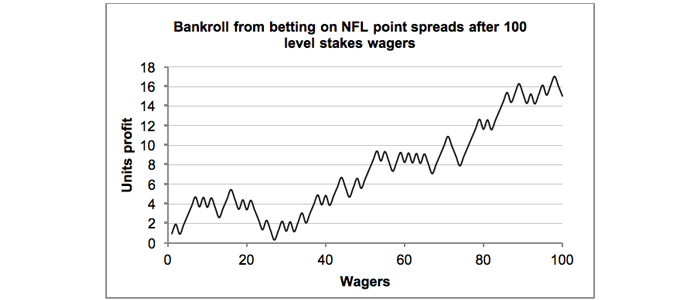
Sports bettors can be particularly prone to faulty pattern recognition through a misplaced belief in the law of small numbers. Misinterpreting profitability from small samples of wagers as representative of a departure from randomness and evidence of predictive skill can have unpleasant financial consequences over the longer term. Consider the hypothetical profitability chart of 100 wagers on NFL point spreads below. Each bet is struck at a price of 1.95. Impressive, isn’t it?


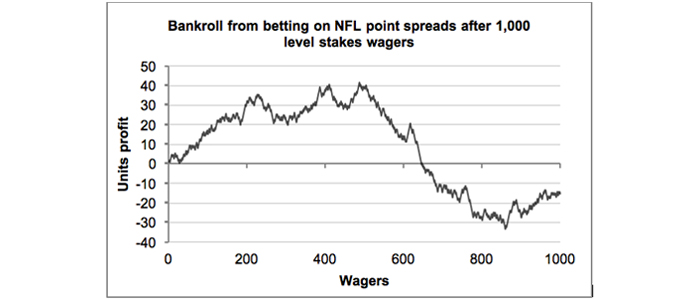
What if I told you this record comes from a well-known US sports handicapper? With a decent growth trend and a yield of 15% you might be forgiven for believing me. Of course, I’m lying. In fact, the next chart of 1,000 wagers reveals the bigger picture.


Really there was no long term profitability to be had at all. The reason: this was merely produced by a random number generator which assumed a 50% chance of an individual win and a profit expectation of -2.5%. The first chart simply represents the initial 100 wagers of the second.

Yet even in the second longer time series a healthy profitability was maintained for several hundred wagers. Furthermore, despite showing an overall loss, the pattern of the time series looks anything but random, with a fairly consistent wave-like pattern to it.

However, as Kahneman and Tversky recognised, we are far more likely to perceive sequences of similar outcomes as being non-random even if there is no underlying mechanism behind them. Of the two binary sequences below, which looks random and which not?

0, 0, 0, 0 1, 1, 1, 1, 0, 0, 1, 1, 0, 0, 1, 1, 1, 1, 1, 1

0, 1, 1, 0, 1, 0, 0, 0, 1, 1, 0, 0, 1, 0, 1, 0, 0, 1, 1, 1

The majority of people would pick the second sequence. In fact, the first was generated randomly in Excel and I made up the second purposely with shorter sequences of 1s and 0s. When asked to create random sequences like this many of us will switch from 1 to 0 or vice versa if we feel that one of them is happening too often.

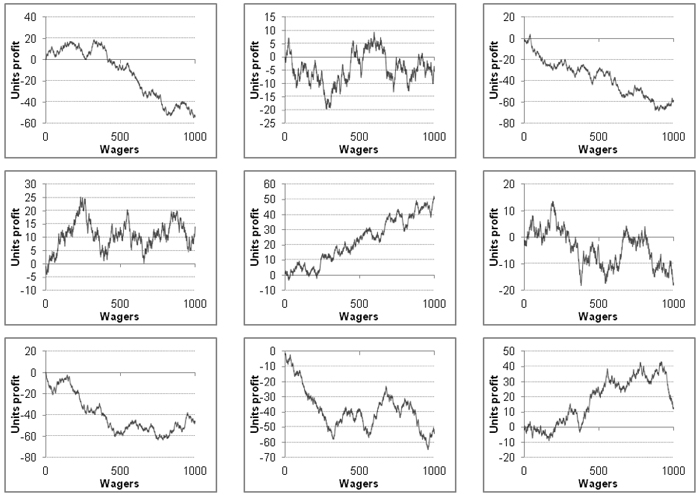
Now take a look at the following 1,000-wager charts. They were all randomly generated. The large range of possible outcomes should provide you with a flavour of just how easy it is to be fooled by apparently meaningful patterns.


Remember, these are not series of 100 wagers, but 1,000. Take a look at the middle one. It has all the hallmarks of an expert tipster or bettor with a 5% yield and solid profit growth throughout the entire sequence of betting, the sort of performance the best handicappers are capable of long term. And yet it happened just by chance.

Using the binomial distribution we can work out the probability of still being in profit after a period of betting despite having an expectation of -2.5%.

Number of Wagers (odds 1.95, 50% win probability) / Minimum number of wins needed / Probability of being in profit

100 52 38.22%
250 129 32.90%
500 257 28.05%
1000 513 21.46%
2500 1283 9.68%
5000 2565 3.40%
10000 5129 0.51%

After 1,000 wagers we still have over a 1-in-5 chance of being in the black despite our betting being nothing more than random. If we placed one handicap bet on every NFL game played, this would take us nearly four seasons. That’s a long time to believe we have anything other than luck on our side.

How small is small?

The law of small numbers is a cognitive bias where people show a tendency to believe that a relatively small number of observations will closely reflect the general population. Furthermore, as this exercise has shown, small can sometimes be quite large. It exists because people favour certainty over doubt, explanation over ignorance, causation over association, patterns over randomness and skill (particularly self-serving skill) over chance. For sports bettors, failure to truly appreciate its significance can be costly.

MLB: T-Bone System

The T-Bone System (named after the person who came up with the original idea, although I suspect that isn't his real name) is a regular season baseball (MLB) system backing road favourites (-140 or hotter) coming off a loss, and was introduced in 2016.

Here are the results over the past nine completed seasons, updated to include the 2019 season.


Note that returns are all calculated using the US practice of risking the line to win 100 units when playing favorites, and risking 100 units to win the line when playing on underdogs.

Money Line:
Run Line:
Combined:
The probability that these returns (on straight up bets) are down to luck is estimated to be about 1 in 2,500. 

Expected Value (EV)

Expected value (EV)

In probability theory, the expected value (EV) of a random variable is the weighted average of all possible values a random variable can take on.

The expected value may be intuitively understood by the law of large numbers: It can be interpreted as the long-run average of the results of many independent repetitions of an experiment (e.g. a dice roll).

Example: If you roll a dice, the possible outcomes are 1, 2, 3, 4, 5 or 6 – all with equal probability of 1/6. The expected value of a dice roll is 3.5.

This example shows that the "expected value" is not a result that may be "expected" in the ordinary sense. Rolling a 3.5 with a dice (or having 2.5 children) is impossible.

In trading, we can speak of EV as the estimated value of an investment with unknown return.

A simple example on EV in trading

We can buy an apple for $10. We expect the following (based on analysis or on our experience):
A likelihood of 50% that we can sell the apple for $16.
A likelihood of 25% that we can sell the apple for $12.
A likelihood of 25% that we will not be able to sell the apple and it goes bad.

The expected revenue of the "apple deal" would be:

(50% x $16) + (25% x $12) + (25% x $0) = $8 + $3 + $0 = $11.

Thus, the expected value of the transaction would be $11 minus the $10 that we spend for the apple. The resulting EV of $1 is positive, indicating that doing the deal would be profitable, or "+EV".

The return on investment in this scenario would be +10%.


In many situations, the expected value of an investment can be estimated with thorough analysis.

Positive result versus positive expected value

Differentiating between a positive result and a positive expected result is a key skill needed for every trader.

A trade that made you profit might in fact have had a negative expected value. And a trade that made you a loss might in fact have had a positive expected value.

Coming back to the dice example: you bet $100 on the result of a single dice roll being larger than 2. Obviously, this is a good bet. Still, the result might be a 1 – and you lose the bet.

EV and money management

It also is obvious that you should not bet your life on the dice roll, even if your bet has a positive expected value. The potential loss simply is far too big. This is a good example that shows that you should not take any trade or bet, even if you have a positive expected value.

This is one of the fundamental ideas behind money management. Do trades with a positive expected value, but do not invest more than 1-2% into a single trade. Otherwise, the risk of going broke despite making the right decisions simply is too large.

Lay Last Loser

The Lay Last Loser System is used in the top five English Football Leagues, and lays the last team to lose in each division until they win again. The idea was found on a post on the Betfair Forum and suggested excluding the Premier League and laying teams in their next two games. I have modified this to include the English Premier League and to keep laying teams until they win again.

The reasoning appears to be that once a team loses, the market rates them higher than the team might rate themselves! Confidence is powerful, and a loss can quickly make a serious dent in it.

The system is complete for the 2015-16 season, with the final summary as below:

The 2016-17 season saw this system take a small loss:

The Smart Money: How the World's Best Sports Bettors Beat the Bookies Out of Millions

A Book of Gambling Secrets, but Some Are Easily Spilled
By EDWARD WYATT

Published: November 11, 2004

In the world of gambling, secrets do not last long, and it is not always easy to tell when someone is bluffing.

Those two maxims could weigh on the minds of editors at Simon & Schuster over the next year as it prepares to publish "The Smart Money: How the World's Best Sports Bettors Beat the Bookies Out of Millions."

The book is said to be the true story of the Brain Trust, a group of professional gamblers that legally wagers hundreds of thousands of dollars in Las Vegas each week on college and professional football games, making it one of the most influential forces in the gambling world.

The book's author was a participant in the group for seven years, first as a courier betting the syndicate's money, then as the operator of his own, smaller gambling ring affiliated with the Brain Trust. The proposal identifies him only as 44, an identity adopted, the author said, to protect the privacy of some of the participants in the gambling ring.

Books about gambling have been hugely popular in recent years, and the proposal for "The Smart Money" reads like an edge-of-the-seat thriller, one made all the more intriguing by the likelihood that it is true. David Rosenthal, the publisher of Simon & Schuster's flagship imprint, and Marysue Rucci, a senior editor there, agreed two weeks ago to buy the book for an advance of roughly $500,000. Publication is scheduled for October.

Simon & Schuster hopes to add an extra element of suspense by having the author wager some of his advance on the number of copies of the book sold in the first year: exceeding a certain number wins 44 a bonus, while falling short of the mark means the author has to return some of his advance.

But both the publisher and the author face several potential pitfalls. While all gamblers lie sometimes, changing the identifying details in a purportedly nonfiction book leaves readers in the uncomfortable position of not knowing which parts are really true. And it turns out that the supposedly anonymous players in this gambling drama are, in fact, very well known. A few hours of Googling and database searching by a reporter led to the real identities of 44, the Brain Trust and its principal character. The author is Michael Konik, a freelance writer who worked for several years for Bill Walters, a Las Vegas developer who is one of the country's biggest sports bettors.

The book proposal identifies the leader of the gambling ring as Rick Matthews, describing him as "the kingpin of American sports betting," a philanthropist, restaurateur and Southerner who, by dint of being "one of the greatest golf hustlers of all time," is "a millionaire several times over."

Those descriptions make it relatively easy to determine that Rick Matthews is actually Mr. Walters, a Kentucky native who now spends much of his time developing golf courses in Las Vegas. In a telephone interview, Mr. Walters, whose gambling history has been explored many times in magazine and newspaper profiles, confirmed that he is Rick Matthews.

For years Mr. Walters has run the Computer Group, a betting syndicate that uses computers to analyze reams of information on sports teams and players, placing enormous bets when it determines the point spread in Las Vegas books is out of line with its own calculation. Mr. Walters has been indicted at least three times in federal or Nevada state courts on charges of illegal gambling, but the indictments have been dismissed each time; he has never been convicted of any gambling charge. In 1999 The Las Vegas Review-Journal named him as one of the 10 most influential nonparticipant figures in sports.

Mr. Walters and others also said 44 was Mr. Konik, a television commentator on poker matches for Fox Sports who has written extensively about gambling and golf. Among his several books is "The Man With the $100,000 Breasts and Other Gambling Stories" (Huntington Press, 1999), which includes a profile of a high-stakes golf hustler who is a thinly disguised Mr. Walters.

Mr. Konik, reached at his home in Los Angeles, declined to discuss whether he was 44. Mr. Rosenthal, the publisher, also said he had no comment about Mr. Konik's relationship to 44.

In an earlier telephone interview, arranged by his literary agent, Jennifer Joel of International Creative Management, the anonymous 44 sounded much like Mr. Konik. In the interview, the author said all the events to be described in the book were true and were based on an extensive journal kept during his tenure at the gambling group, from 1996 to 2003. According to the proposal, the author recorded in the journal his gambling wins and losses, brushes with the law and "the stunning sensation of actually holding $1 million worth of cash in my hands."

But the author said he believed that he needed to change identifying details of people in the book because many of the participants in the gambling ring, as well as the peripheral characters in the casinos and elsewhere, are not public figures. As such, their abilities to sue successfully for libel or defamation are greater than they would be if they intentionally sought publicity.

The author also said that while all of his gambling activities were legal, not everyone who knows him is aware of his gambling venture, and he would rather keep it that way. The details revealed in the book proposal, however, seem unlikely to allow that to happen. The proposal details the author's start-up of his own gambling circle, which he calls "the Hollywood boys" and which includes some well-known but as-yet-unidentified celebrities.

Mr. Rosenthal, the publisher, said he did not think that the book needed an anonymous author to succeed. But so far, at least, he said he was willing to honor the author's desire to remain unknown. "He's not a C.I.A. station chief, but he has some specific reasons for wanting to keep his identity under wraps," Mr. Rosenthal said. "It's important to him, which I respect. But I think I could do it either way."


Michael Konik went along for a gut-crunching ride as Big Daddy beat the bookies

Reviewed by Jeff Ostrowski
December 31, 2006

Anybody who has played the office football pool knows how easy it is to fancy yourself an expert handicapper, and just how hard it is to outsmart the Las Vegas line. The matchups sit there like ripe fruit to be plucked. How can the unbeaten Bears be mere 10-point favorites against the lowly Dolphins? Then Rex Grossman throws three interceptions, the Bears lose three fumbles, and the Dolphins win easily.

Add in the bookies' 10 percent commission – which means you have to be right more than half the time just to break even – and you get an idea why casinos are so profitable.

Michael Konik knows these gut-wrenching ups and downs all too well. The magazine writer spent four football seasons as part of a gambling syndicate, an experience that taught him two lessons: Yes, you can outsmart the bookies. And no, it's not worth it.

Not unless you possess ironclad nerves and a bottomless well of patience. You had also better know a programmer who can whip up an algorithm to pick the winners, because opinions and hunches make for sucker bets.

Konik's introduction to this clandestine world came in 1997, when he met Rick “Big Daddy” Matthews. The legendary sports gambler recruited the scribe to work as one of the dupes who placed bets on behalf of Matthews' Brain Trust.

Matthews needed the help because every bookie in Las Vegas had refused his business. So Konik showed up at Caesar's Palace and concocted a story painting him as a high roller who'd cashed a big advance for a screenplay. In fact, he was simply moving Matthews' money.

But there was no such person as Rick “Big Daddy” Matthews, no such syndicate as the Brain Trust; both are names Konik made up. The New York Times and Las Vegas Review-Journal have reported that Konik's boss actually was Las Vegas developer and gambler Billy Walters, and the syndicate was known as the Computer Group.

Konik floats through the first-season honeymoon in which he is entrusted with briefcases full of cash, gets a front-row seat on the action and enjoys the high-roller treatment at Vegas' poshest casinos. The money isn't bad, either. As one of Big Daddy's operatives, Konik keeps 10 percent of the winnings but risks none of the losses.

But he operates under a constant cloud of suspicion: The bookies suspect that he works for Matthews, and any time he launches a winning streak, they limit his bets or close his account. Konik's girlfriend, tired of his gambling obsession, moves out.

By 1999, with offshore casinos booking millions through the Internet, Konik moves his money online, but he finds that the bookies in Costa Rica and Antigua are even slipperier than his pals in Vegas.

Konik deftly builds suspense throughout his fast-paced account, and it's not giving away too much to say that he finally decides that he's just not cut out to be another Big Daddy.

“All the time and psychic energy I devote to wagering on sports surely could be better spent on something else,” he writes in an uncharacteristic bout of introspection. “Anything else.”

© Cox News Service